Get Free Shipping on orders over $79
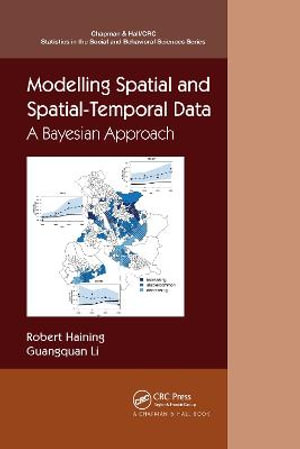
Modelling Spatial and Spatial-Temporal Data : A Bayesian Approach - Robert P. Haining

Modelling Spatial and Spatial-Temporal Data

A Bayesian Approach

By: Robert P. Haining, Guangquan Li

eText | 27 January 2020 | Edition Number 1

At a Glance

eText


$113.29

or 4 interest-free payments of $28.32 with

 or 

Instant online reading in your Booktopia eTextbook Library *

Why choose an eTextbook?

Instant Access *

Purchase and read your book immediately

Read Aloud

Listen and follow along as Bookshelf reads to you

Study Tools

Built-in study tools like highlights and more

* eTextbooks are not downloadable to your eReader or an app and can be accessed via web browsers only. You must be connected to the internet and have no technical issues with your device or browser that could prevent the eTextbook from operating.

Modelling Spatial and Spatial-Temporal Data: A Bayesian Approach is aimed at statisticians and quantitative social, economic and public health students and researchers who work with spatial and spatial-temporal data. It assumes a grounding in statistical theory up to the standard linear regression model. The book compares both hierarchical and spatial econometric modelling, providing both a reference and a teaching text with exercises in each chapter. The book provides a fully Bayesian, self-contained, treatment of the underlying statistical theory, with chapters dedicated to substantive applications. The book includes WinBUGS code and R code and all datasets are available online.

Part I covers fundamental issues arising when modelling spatial and spatial-temporal data. Part II focuses on modelling cross-sectional spatial data and begins by describing exploratory methods that help guide the modelling process. There are then two theoretical chapters on Bayesian models and a chapter of applications. Two chapters follow on spatial econometric modelling, one describing different models, the other substantive applications. Part III discusses modelling spatial-temporal data, first introducing models for time series data. Exploratory methods for detecting different types of space-time interaction are presented followed by two chapters on the theory of space-time separable (without space-time interaction) and inseparable (with space-time interaction) models. An applications chapter includes: the evaluation of a policy intervention; analysing the temporal dynamics of crime hotspots; chronic disease surveillance; and testing for evidence of spatial spillovers in the spread of an infectious disease. A final chapter suggests some future directions and challenges.

on
Desktop
Tablet
Mobile

Other Editions and Formats

Paperback

Published: 30th September 2021

More in Probability & Statistics

All of Regression - Isabella Verdinelli

eTEXT

$104.95

Bayesian Workflow - Andrew Gelman

eTEXT

$116.60