Get Free Shipping on orders over $0
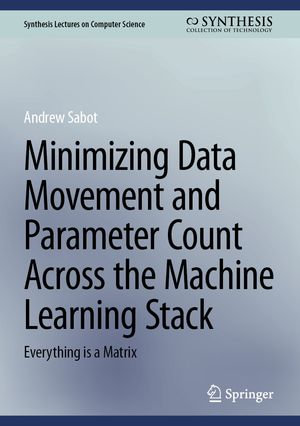
Minimizing Data Movement and Parameter Count Across the Machine Learning Stack : Everything is a Matrix - Andrew Sabot

Minimizing Data Movement and Parameter Count Across the Machine Learning Stack

Everything is a Matrix

By: Andrew Sabot

eText | 3 August 2026

At a Glance

eText


$64.99

or 4 interest-free payments of $16.25 with

 or 

Instant online reading in your Booktopia eTextbook Library *

Why choose an eTextbook?

Instant Access *

Purchase and read your book immediately

Read Aloud

Listen and follow along as Bookshelf reads to you

Study Tools

Built-in study tools like highlights and more

* eTextbooks are not downloadable to your eReader or an app and can be accessed via web browsers only. You must be connected to the internet and have no technical issues with your device or browser that could prevent the eTextbook from operating.

This book provides a focused, research-forward guide to making large AI models efficient in practice and also presents an array of novel techniques to reduce memory footprint, accelerate computation, and improve overall hardware utilization. The author demonstrates that substantial efficiency gains can be achieved by rethinking how data is computed, stored, and compressed, with a special focus on matrices, the core computational structure underpinning both scientific computing and neural networks. Modern AI models run on huge grids of numbers (matrices/tensors), and their speed and affordability depend on how those numbers are arranged and processed on real hardware (GPUs/TPUs/CPUs). This book explains practical methods to skip unnecessary work (structured sparsity), move data efficiently (gather/scatter), and shrink models without losing accuracy (block distillation) so that AI systems can use less memory, less time, and less energy without sacrificing quality. In addition, the book shows how to turn algorithmic ideas into hardware-aware speedups on GPUs/TPUs. Readers will learn when sparsity pays off, how to schedule irregular workloads, and how to recover accuracy in compressed models. Case studies illustrate end-to-end design choices, evaluation, and pitfalls.The result is a coherent perspective that bridges theory, compilers/run times, and real-world deployment.

on
Desktop
Tablet
Mobile

More in Artificial Intelligence

HBR Guide to Generative AI for Teams : HBR Guide - Gabriele Rosani

eBOOK

The Pigeon Strategy - Hajrë Hyseni

eBOOK