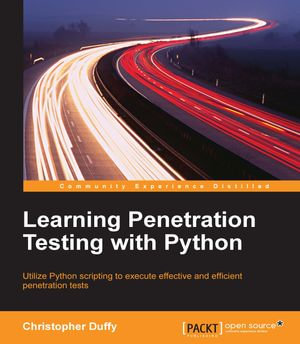
Book Description
Utilize Python scripting to execute effective and efficient penetration tests
About This Book
Understand how and where Python scripts meet the need for penetration testing
Familiarise yourself with the process of highlighting a specific methodology to exploit an environment to fetch critical data
Develop your Python and penetration testing skills with real-world examples
Who This Book Is For
If you are a security professional or researcher, with knowledge of different operating systems and a conceptual idea of penetration testing, and you would like to grow your knowledge in Python, then this book is ideal for you.
What You Will Learn
Familiarise yourself with the generation of Metasploit resource files
Use the Metasploit Remote Procedure Call (MSFRPC) to automate exploit generation and execution
Use Python's Scapy, network, socket, office, Nmap libraries, and custom modules
Parse Microsoft Office spreadsheets and eXtensible Markup Language (XML) data files
Write buffer overflows and reverse Metasploit modules to expand capabilities
Exploit Remote File Inclusion (RFI) to gain administrative access to systems with Python and other scripting languages
Crack an organization's Internet perimeter
Chain exploits to gain deeper access to an organization's resources
Interact with web services with Python
In Detail
Python is a powerful new-age scripting platform that allows you to build exploits, evaluate services, automate, and link solutions with ease. Python is a multi-paradigm programming language well suited to both object-oriented application development as well as functional design patterns. Because of the power and flexibility offered by it, Python has become one of the most popular languages used for penetration testing.
This book highlights how you can evaluate an organization methodically and realistically. Specific tradecraft and techniques are covered that show you exactly when and where industry tools can and should be used and when Python fits a need that proprietary and open source solutions do not.
Initial methodology, and Python fundamentals are established and then built on. Specific examples are created with vulnerable system images, which are available to the community to test scripts, techniques, and exploits. This book walks you through real-world penetration testing challenges and how Python can help.
From start to finish, the book takes you through how to create Python scripts that meet relative needs that can be adapted to particular situations. As chapters progress, the script examples explain new concepts to enhance your foundational knowledge, culminating with you being able to build multi-threaded security tools, link security tools together, automate reports, create custom exploits, and expand Metasploit modules.
Style and approach
This book is a practical guide that will help you become better penetration testers and/or Python security tool developers. Each chapter builds on concepts and tradecraft using detailed examples in test environments that you can simulate.
What you will learn
- Familiarise yourself with the generation of Metasploit resource files
- Use the Metasploit Remote Procedure Call (MSFRPC) to automate exploit generation and execution
- Use Python's Scapy, network, socket, office, Nmap libraries, and custom modules
- Parse Microsoft Office spreadsheets and eXtensible Markup Language (XML) data files
- Write buffer overflows and reverse Metasploit modules to expand capabilities
- Exploit Remote File Inclusion (RFI) to gain administrative access to systems with Python and other scripting languages
- Crack an organization's Internet perimeter
- Chain exploits to gain deeper access to an organization's resources
- Interact with web services with Python
Who this book is for
If you are a security professional or researcher, with knowledge of different operating systems and a conceptual idea of penetration testing, and you would like to grow your knowledge in Python, then this book is ideal for you.