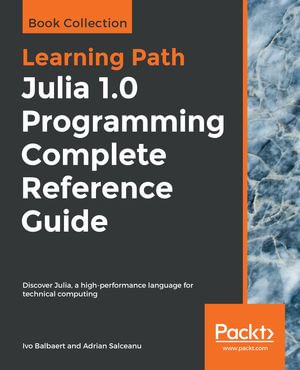
Learn dynamic programming with Julia to build apps for data analysis, visualization, machine learning, and the web
Key Features
- Leverage Julia's high speed and efficiency to build fast, efficient applications
- Perform supervised and unsupervised machine learning and time series analysis
- Tackle problems concurrently and in a distributed environment
Book Description
Julia offers the high productivity and ease of use of Python and R with the lightning-fast speed of C++. There's never been a better time to learn this language, thanks to its large-scale adoption across a wide range of domains, including fintech, biotech and artificial intelligence (AI).
You will begin by learning how to set up a running Julia platform, before exploring its various built-in types. This Learning Path walks you through two important collection types: arrays and matrices. You'll be taken through how type conversions and promotions work, and in further chapters you'll study how Julia interacts with operating systems and other languages. You'll also learn about the use of macros, what makes Julia suitable for numerical and scientific computing, and how to run external programs.
Once you have grasped the basics, this Learning Path goes on to how to analyze the Iris dataset using DataFrames. While building a web scraper and a web app, you'll explore the use of functions, methods, and multiple dispatches. In the final chapters, you'll delve into machine learning, where you'll build a book recommender system.
By the end of this Learning Path, you'll be well versed with Julia and have the skills you need to leverage its high speed and efficiency for your applications.
This Learning Path includes content from the following Packt products:
- Julia 1.0 Programming - Second Edition by Ivo Balbaert
- Julia Programming Projects by Adrian Salceanu
What you will learn
- Create your own types to extend the built-in type system
- Visualize your data in Julia with plotting packages
- Explore the use of built-in macros for testing and debugging
- Integrate Julia with other languages such as C, Python, and MATLAB
- Analyze and manipulate datasets using Julia and DataFrames
- Develop and run a web app using Julia and the HTTP package
- Build a recommendation system using supervised machine learning
Who this book is for
If you are a statistician or data scientist who wants a quick course in the Julia programming language while building big data applications, this Learning Path is for you. Basic knowledge of mathematics and programming is a must.