Get Free Shipping on orders over $79
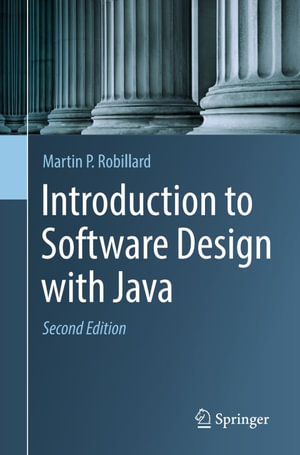
Introduction to Software Design with Java - Martin P. Robillard

Introduction to Software Design with Java

By: Martin P. Robillard

eText | 3 May 2022 | Edition Number 2

At a Glance

eText


$74.99

or 4 interest-free payments of $18.75 with

 or 

Instant online reading in your Booktopia eTextbook Library *

Why choose an eTextbook?

Instant Access *

Purchase and read your book immediately

Read Aloud

Listen and follow along as Bookshelf reads to you

Study Tools

Built-in study tools like highlights and more

* eTextbooks are not downloadable to your eReader or an app and can be accessed via web browsers only. You must be connected to the internet and have no technical issues with your device or browser that could prevent the eTextbook from operating.
This textbook provides an in-depth introduction to software design, with a focus on object-oriented design, and using the Java programming language. Its goal is to help readers learn software design by discovering the experience of the design process. To this end, the text follows a continuous narrative that introduces each element of design know-how in context, and explores alternative solutions in that context. This narrative is complemented by hundreds of code fragments and design diagrams. The first chapter is a general introduction to software design and the subsequent chapters cover design concepts and techniques. The concepts and techniques covered include interfaces, encapsulation, inheritance, design patterns, composition, functional-style design, unit testing, and many more. A major emphasis is placed on coding and experimentation as a necessary complement to reading the text. To support this aspect of the learning process, a companion website with practice exercises is provided, as well as two complete sample applications. Guidance on these sample applications is provided in "Code Exploration" insets throughout the book. Although the Java language is used as a means of conveying design-related ideas, the book's main goal is to address concepts and techniques that are applicable in a host of technologies. This second edition covers additional design techniques such as input validation and dependency injection. It also provides extended and revised treatment of many core subjects, including polymorphic copying, unit testing, the Observer pattern, and functional-style programming. This book is intended for readers who have a minimum of programming experience and want to move from writing small programs and scripts to tackling the development of larger systems. This audience naturally includes students in university-level computer science and software engineering programs. As the prerequisites to specific computing concepts are kept to a minimum, the content is also accessible to programmers with no previous background in computing. In a similar vein, understanding the code fragments requires only a minimal grasp of the Java language, such as would be taught in an introductory programming course.
on
Desktop
Tablet
Mobile

More in Software Engineering

The End of Leadership - Barbara Kellerman

eBOOK

The Debugging Handbook - Johannes Kuhlmann

eBOOK

RRP $67.77

$54.99

19%
OFF