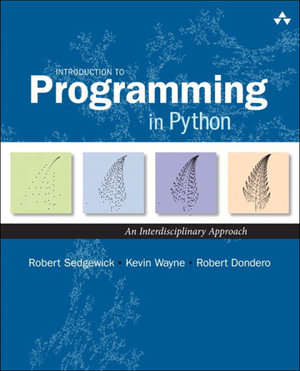
Today, anyone in a scientific or technical discipline needs programming skills. Python is an ideal first programming language, and Introduction to Programming in Python is the best guide to learning it.
Princeton University's Robert Sedgewick, Kevin Wayne, and Robert Dondero have crafted an accessible, interdisciplinary introduction to programming in Python that emphasizes important and engaging applications, not toy problems. The authors supply the tools needed for students to learn that programming is a natural, satisfying, and creative experience.
This example-driven guide focuses on Python's most useful features and brings programming to life for every student in the sciences, engineering, and computer science.
Coverage includes
- Basic elements of programming: variables, assignment statements, built-in data types, conditionals, loops, arrays, and I/O, including graphics and sound
- Functions, modules, and libraries: organizing programs into components that can be independently debugged, maintained, and reused
- Object-oriented programming and data abstraction: objects, modularity, encapsulation, and more
- Algorithms and data structures: sort/search algorithms, stacks, queues, and symbol tables
- Examples from applied math, physics, chemistry, biology, and computer science—all compatible with Python 2 and 3
Drawing on their extensive classroom experience, the authors provide Q&As, exercises, and opportunities for creative practice throughout. An extensive amount of supplementary information is available at introcs.cs.princeton.edu/python. With source code, I/O libraries, solutions to selected exercises, and much more, this companion website empowers people to use their own computers to teach and learn the material.