Get Free Shipping on orders over $79
Inductive Logic Programming : 18th International Conference, ILP 2008 Prague, Czech Republic, September 10-12, 2008, Proceedings - Filip Zelezny

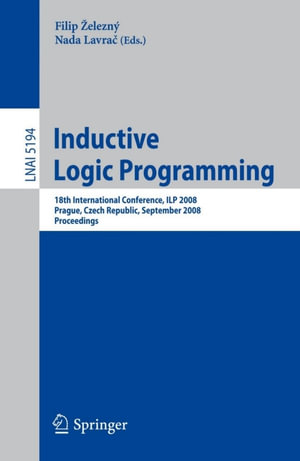
Inductive Logic Programming

18th International Conference, ILP 2008 Prague, Czech Republic, September 10-12, 2008, Proceedings

By: Filip Zelezny, Nada Lavrac

eText | 29 August 2008 | Edition Number 1

At a Glance

eText


$84.99

or 4 interest-free payments of $21.25 with

 or 

Instant online reading in your Booktopia eTextbook Library *

Why choose an eTextbook?

Instant Access *

Purchase and read your book immediately

Read Aloud

Listen and follow along as Bookshelf reads to you

Study Tools

Built-in study tools like highlights and more

* eTextbooks are not downloadable to your eReader or an app and can be accessed via web browsers only. You must be connected to the internet and have no technical issues with your device or browser that could prevent the eTextbook from operating.
The 18th International Conference on Inductive Logic Programming was held in Prague, September 10-12, 2008. ILP returned to Prague after 11 years, and it is tempting to look at how the topics of interest have evolved during that time. The ILP community clearly continues to cherish its beloved ?rst-order logic representation framework. This is legitimate, as the work presented at ILP 2008 demonstrated that there is still room for both extending established ILP approaches (such as inverse entailment) and exploring novel logic induction frameworks (such as brave induction). Besides the topics lending ILP research its unique focus, we were glad to see in this year's proceedings a good n- ber of papers contributing to areas such as statistical relational learning, graph mining, or the semantic web. To help open ILP to more mainstream research areas, the conference featured three excellent invited talks from the domains of the semantic web (Frank van Harmelen), bioinformatics (Mark Craven) and cognitive sciences (Josh Tenenbaum). We deliberately looked for speakers who are not directly involved in ILP research. We further invited a tutorial on stat- tical relational learning (Kristian Kersting) to meet the strong demand to have the topic presented from the ILP perspective. Lastly, Stefano Bertolo from the European Commission was invited to give a talk on the ideal niches for ILP in the current EU-supported research on intelligent content and semantics.
on
Desktop
Tablet
Mobile

More in Artificial Intelligence

AI-Powered Search - Trey Grainger

eBOOK

HBR Guide to Generative AI for Managers : HBR Guide - Elisa Farri

eBOOK

AI : The End of Human Race - Alex Wood

eBOOK