

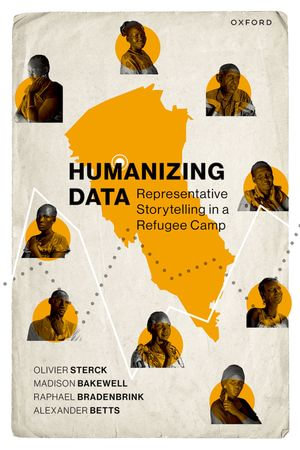
Humanizing Data : Representative Storytelling in a Refugee Camp - Olivier Sterck

Humanizing Data

Representative Storytelling in a Refugee Camp

By: Olivier Sterck, Madison Bakewell, Raphael Bradenbrink, Alexander Betts

eText | 29 October 2026

At a Glance

eText


$91.83

or 4 interest-free payments of $22.96 with

 or 

Available: 29th October 2026

Preorder. Online access available after release.

Why choose an eTextbook?

Instant Access *

Purchase and read your book immediately

Read Aloud

Listen and follow along as Bookshelf reads to you

Study Tools

Built-in study tools like highlights and more

* eTextbooks are not downloadable to your eReader or an app and can be accessed via web browsers only. You must be connected to the internet and have no technical issues with your device or browser that could prevent the eTextbook from operating.


Humanizing Data immerses readers in the everyday life of the Kakuma refugee camp, one the largest refugee camps in Africa. While the media frequently offers sensationalist portrayals of refugees as victims, heroes, or villains, this book adopts an alternative methodology called Representative Storytelling that enables readers to situate individual stories in relation to the experience of the wider population.


Based on long-term extensive research within the camp, including large-scale quantitative data collection, the authors worked with nine households located at different points on the camp's income distribution curve to tell their own stories in their own words. The result is nine in-depth narratives, which the reader is able to contextualise because they represent the full spectrum of living standards within the camp. As the protagonists highlight particular themes such as humanitarian aid, food insecurity, education, health, employment, the authors draw upon their wider research to explain how representative those accounts are of the wider population. The result is a comprehensive understanding of life in Kakuma, and an invitation to reflect on how we can combine human stories and statistics to support public understanding of the lives of distant strangers.


This is an open access title. It is available to read and download as a free PDF version on Oxford Academic and is made available under a Creative Commons Attribution-Non Commercial-No Derivatives 4.0 International licence.

on
Desktop
Tablet
Mobile

More in Development Studies