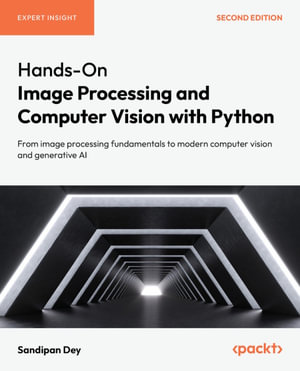
Explore the world of image processing, computer vision, and generative AI with Python—from fundamental concepts and classical methods to deep learning, modern vision systems, and real-world visual content generation. Free with your book: DRM-free PDF version + access to Packt's next-gen Reader*
Key Features
- Build end-to-end image processing and computer vision pipelines with Python
- Master image enhancement, restoration, filtering, segmentation, classification, and object detection
- Explore CNNs, Vision Transformers, diffusion models, foundation models, and vision-language AI
- Purchase of the print or Kindle book includes a free PDF eBook
Book Description
Analyzing and understanding visual data has become essential in modern applications such as healthcare, security, remote sensing, manufacturing, and digital media. This book provides a hands-on guide to image processing and computer vision using Python, following a practical approach that bridges theory with implementation. As you progress through the chapters, you will develop proficiency in Python 3 and implement algorithms spanning classical image processing, modern computer vision, and state-of-the-art (SOTA) deep learning and generative AI. The book covers image enhancement, restoration, filtering, segmentation, feature extraction, classification, and object detection using libraries including NumPy, OpenCV, PIL, SciPy, scikit-image, scikit-learn, TensorFlow, Keras, and PyTorch. Advanced chapters introduce CNNs, Vision Transformers, transformer-based segmentation, modern detection frameworks, GANs, diffusion models, foundation models, image-to-image translation, super-resolution, and multimodal vision-language understanding. Real-world applications span medical imaging, remote sensing, banking, augmented reality, autonomous driving, industrial inspection, and intelligent visual analytics. By the end of the book, you will be equipped to design and implement real-world visual computing solutions. *Email sign-up and proof of purchase required
What you will learn
- Build image processing and computer vision pipelines
- Apply image enhancement, restoration, and segmentation
- Implement image classification and object detection models
- Explore CNNs, Vision Transformers, and attention models
- Generate and edit images using GANs and diffusion models
- Develop multimodal vision-language AI applications
- Apply visual AI across diverse real-world domains
- Implement super-resolution, style transfer, and image-to-image translation
Who this book is for
This book is for computer vision engineers, machine learning engineers, AI engineers, Python developers, data scientists, and applied researchers building real-world visual AI systems. It is ideal for professionals working in image analysis, medical imaging, remote sensing, industrial inspection, autonomous systems, surveillance, augmented reality, and visual analytics. Students and software engineers seeking hands-on experience with classical image processing, deep learning, modern vision models, and generative AI will also benefit. A working knowledge of Python is required.