

Get Free Shipping on orders over $79
GPT for Python-Coding in Computational Materials Science and Mechanics : From Prompt Engineering to Solutions in Worked-Out Examples - Bernhard Eidel

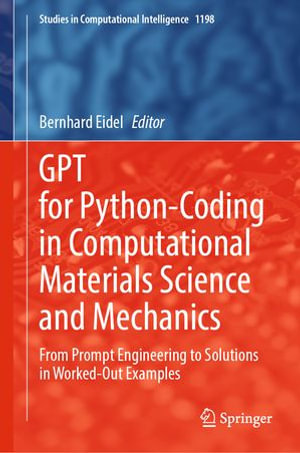
GPT for Python-Coding in Computational Materials Science and Mechanics

From Prompt Engineering to Solutions in Worked-Out Examples

By: Bernhard Eidel (Editor)

eText | 20 June 2025

At a Glance

eText


$279.00

or 4 interest-free payments of $69.75 with

 or 

Instant online reading in your Booktopia eTextbook Library *

Why choose an eTextbook?

Instant Access *

Purchase and read your book immediately

Read Aloud

Listen and follow along as Bookshelf reads to you

Study Tools

Built-in study tools like highlights and more

* eTextbooks are not downloadable to your eReader or an app and can be accessed via web browsers only. You must be connected to the internet and have no technical issues with your device or browser that could prevent the eTextbook from operating.

This book covers all the topics about ChatGPT required to successfully generate Python code to solve problems in computational materials science and mechanics, complemented by numerous fully worked-out applications. The complete work flow for AI-assisted coding is given, including: (i) prompt engineering providing a powerful toolset for how to give coding assignments to ChatGPT effectively; (ii) commented code listings; and (iii) tips and tricks to verify the codes in rigorous tests including human interventions to fix issues and gaps. Finally, (iv) the coding projects are critically reviewed to address the strengths and remaining weaknesses of the Chatbot, including explicit recommendations on how to communicate with GPT. For the steps (i)-(iv) the book presents a curated selection of intriguing problems from computational materials science and computational mechanics including machine learning for problem-solving. These problems are carefully chosen for their relevance to current research and industrial applications and their suitability for showcasing the advanced capabilities of GPT-4 for code generation. Spanning from predicting material behavior under various conditions to simulating complex mechanical interactions, the problems serve as a canvas on which GPT-4 paints its solutions, demonstrating not just accuracy but creativity in problem-solving. Therefore, the book serves as a valuable primer for both undergraduate and graduate students, as well as a review for research scientists and practicing engineers.

on
Desktop
Tablet
Mobile

More in Artificial Intelligence

AI-Powered Search - Trey Grainger

eBOOK

HBR Guide to Generative AI for Managers : HBR Guide - Elisa Farri

eBOOK

AI : The End of Human Race - Alex Wood

eBOOK