Get Free Shipping on orders over $79
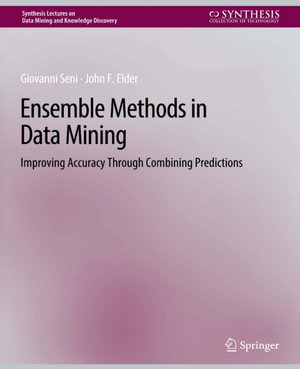
Ensemble Methods in Data Mining : Improving Accuracy Through Combining Predictions - Giovanni Seni

Ensemble Methods in Data Mining

Improving Accuracy Through Combining Predictions

By: Giovanni Seni, John Elder

eText | 1 June 2022

At a Glance

eText


$50.00

or 4 interest-free payments of $12.50 with

 or 

Instant online reading in your Booktopia eTextbook Library *

Why choose an eTextbook?

Instant Access *

Purchase and read your book immediately

Read Aloud

Listen and follow along as Bookshelf reads to you

Study Tools

Built-in study tools like highlights and more

* eTextbooks are not downloadable to your eReader or an app and can be accessed via web browsers only. You must be connected to the internet and have no technical issues with your device or browser that could prevent the eTextbook from operating.
Ensemble methods have been called the most influential development in Data Mining and Machine Learning in the past decade. They combine multiple models into one usually more accurate than the best of its components. Ensembles can provide a critical boost to industrial challenges -- from investment timing to drug discovery, and fraud detection to recommendation systems -- where predictive accuracy is more vital than model interpretability. Ensembles are useful with all modeling algorithms, but this book focuses on decision trees to explain them most clearly. After describing trees and their strengths and weaknesses, the authors provide an overview of regularization -- today understood to be a key reason for the superior performance of modern ensembling algorithms. The book continues with a clear description of two recent developments: Importance Sampling (IS) and Rule Ensembles (RE). IS reveals classic ensemble methods -- bagging, random forests, and boosting -- to be special cases of a single algorithm, thereby showing how to improve their accuracy and speed. REs are linear rule models derived from decision tree ensembles. They are the most interpretable version of ensembles, which is essential to applications such as credit scoring and fault diagnosis. Lastly, the authors explain the paradox of how ensembles achieve greater accuracy on new data despite their (apparently much greater) complexity. This book is aimed at novice and advanced analytic researchers and practitioners -- especially in Engineering, Statistics, and Computer Science. Those with little exposure to ensembles will learn why and how to employ this breakthrough method, and advanced practitioners will gain insight into building even more powerful models. Throughout, snippets of code in R are provided to illustrate the algorithms described and to encourage the reader to try the techniques. The authors are industry experts in data mining and machine learning who are also adjunct professors and popular speakers. Although early pioneers in discovering and using ensembles, they here distill and clarify the recent groundbreaking work of leading academics (such as Jerome Friedman) to bring the benefits of ensembles to practitioners. Table of Contents: Ensembles Discovered / Predictive Learning and Decision Trees / Model Complexity, Model Selection and Regularization / Importance Sampling and the Classic Ensemble Methods / Rule Ensembles and Interpretation Statistics / Ensemble Complexity
on
Desktop
Tablet
Mobile

More in Data Mining

Conquering the Decision Abyss - Keith Hartley

eBOOK

RRP $15.39

$14.99

Investing for Programmers - Stefan Papp

eBOOK

Data Engineering for Data-Driven Marketing - Balamurugan Baluswamy

eBOOK

RRP $186.40

$158.99

15%
OFF