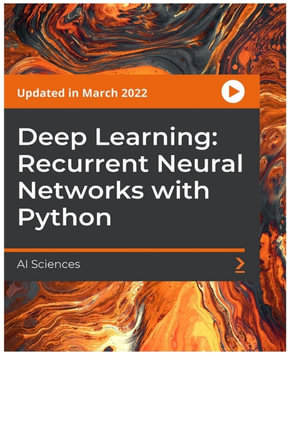
One-stop shop for understanding and implementing recurrent neural networks with Python
Key Features
- Understand and apply fundamentals of recurrent neural networks
- Implement RNNs and related architectures on real-world datasets
- Train RNNs for real-world applications—automatic book writer and stock price prediction
Book Description
With the exponential growth of user-generated data, there is a strong need to move beyond standard neural networks in order to perform tasks such as classification and prediction. Here, architectures such as RNNs, Gated Recurrent Units (GRUs), and Long Short Term Memory (LSTM) are the go-to options. Hence, for any deep learning engineer, mastering RNNs is a top priority.
This course begins with the basics and will gradually equip you with not only the theoretical know-how but also the practical skills required to successfully build, train, and implement RNNs. This course contains several exercises on topics such as gradient descents in RNNs, GRUs, LSTM, and so on. This course also introduces you to implementing RNNs using TensorFlow.
The course culminates in two exciting and realistic projects: creating an automatic book writer and a stock price prediction application. By the end of this course, you will be equipped with all the skills required to confidently use and implement RNNs in your applications.
The code bundle for this course is available at https://github.com/AISCIENCES/mastering_recurrent_neural_networks
What you will learn
- Gain an overview of deep neural networks
- Understand the fundamentals of RNN architectures
- Train real-world datasets using different RNN architectures
- Implement RNNs, LSTM, and GRUs through hands-on exercises
- Create and compile RNN models in TensorFlow
- Perform text classification using RNNs and TensorFlow
Who this book is for
As this course begins with the basics, no prior knowledge in RNNs is required. However, prior experience in Python would be beneficial. Whether you are a beginner, a seasoned data scientist looking to get started with RNNs, business analysts, or if you simply want to implement RNNs in your projects, this course is for you.