Get Free Shipping on orders over $79
Debugging at the Electronic System Level - Frank Rogin

Debugging at the Electronic System Level

By: Frank Rogin, Rolf Drechsler

eText | 17 June 2010

At a Glance

eText


$159.01

or 4 interest-free payments of $39.75 with

 or 

Instant online reading in your Booktopia eTextbook Library *

Why choose an eTextbook?

Instant Access *

Purchase and read your book immediately

Read Aloud

Listen and follow along as Bookshelf reads to you

Study Tools

Built-in study tools like highlights and more

* eTextbooks are not downloadable to your eReader or an app and can be accessed via web browsers only. You must be connected to the internet and have no technical issues with your device or browser that could prevent the eTextbook from operating.

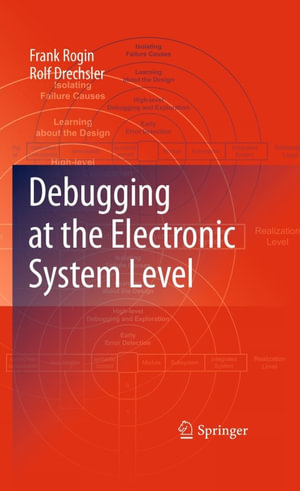
Debugging becomes more and more the bottleneck to chip design productivity, especially while developing modern complex integrated circuits and systems at the Electronic System Level (ESL). Today, debugging is still an unsystematic and lengthy process. Here, a simple reporting of a failure is not enough, anymore. Rather, it becomes more and more important not only to find many errors early during development but also to provide efficient methods for their isolation. In Debugging at the Electronic System Level the state-of-the-art of modeling and verification of ESL designs is reviewed. There, a particular focus is taken onto SystemC. Then, a reasoning hierarchy is introduced. The hierarchy combines well-known debugging techniques with whole new techniques to improve the verification efficiency at ESL. The proposed systematic debugging approach is supported amongst others by static code analysis, debug patterns, dynamic program slicing, design visualization, property generation, and automatic failure isolation. All techniques were empirically evaluated using real-world industrial designs. Summarized, the introduced approach enables a systematic search for errors in ESL designs. Here, the debugging techniques improve and accelerate error detection, observation, and isolation as well as design understanding.

on
Desktop
Tablet
Mobile

More in Circuits & Components