

Get Free Shipping on orders over $79
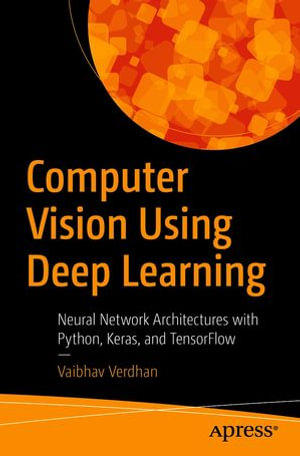
Computer Vision Using Deep Learning : Neural Network Architectures with Python and Keras - Vaibhav Verdhan

Computer Vision Using Deep Learning

Neural Network Architectures with Python and Keras

By: Vaibhav Verdhan

eText | 15 February 2021

At a Glance

eText


$89.99

or 4 interest-free payments of $22.50 with

 or 

Instant online reading in your Booktopia eTextbook Library *

Why choose an eTextbook?

Instant Access *

Purchase and read your book immediately

Read Aloud

Listen and follow along as Bookshelf reads to you

Study Tools

Built-in study tools like highlights and more

* eTextbooks are not downloadable to your eReader or an app and can be accessed via web browsers only. You must be connected to the internet and have no technical issues with your device or browser that could prevent the eTextbook from operating.

Organizations spend huge resources in developing software that can perform the way a human does. Image classification, object detection and tracking, pose estimation, facial recognition, and sentiment estimation all play a major role in solving computer vision problems.

This book will bring into focus these and other deep learning architectures and techniques to help you create solutions using Keras and the TensorFlow library. You'll also review mutliple neural network architectures, including LeNet, AlexNet, VGG, Inception, R-CNN, Fast R-CNN, Faster R-CNN, Mask R-CNN, YOLO, and SqueezeNet and see how they work alongside Python code via best practices, tips, tricks, shortcuts, and pitfalls. All code snippets will be broken down and discussed thoroughly so you can implement the same principles in your respective environments.

Computer Vision Using Deep Learning offers a comprehensive yet succinct guide that stitches DL and CV together to automate operations, reduce human intervention, increase capability, and cut the costs.

What You'll Learn

  • Examine deep learning code and concepts to apply guiding principals to your own projects
  • Classify and evaluate various architectures to better understand your options in various use cases
  • Go behind the scenes of basic deep learning functions to find out how they work

Who This Book Is For

Professional practitioners working in the fields of software engineering and data science. A working knowledge of Python is strongly recommended. Students and innovators working on advanced degrees in areas related to computer vision and Deep Learning.

on
Desktop
Tablet
Mobile

More in Artificial Intelligence

AI-Powered Search - Trey Grainger

eBOOK