Get Free Shipping on orders over $79
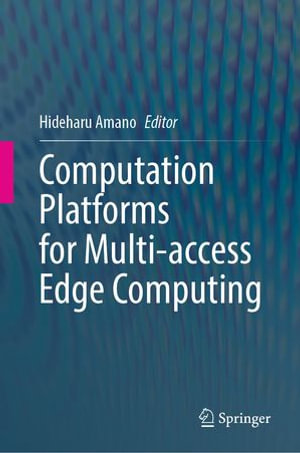
Computation Platforms for Multi-access Edge Computing : Professional and Applied Computing (R0) - Hideharu Amano

Computation Platforms for Multi-access Edge Computing

By: Hideharu Amano (Editor)

eText | 19 November 2025

At a Glance

eText


$249.00

or 4 interest-free payments of $62.25 with

 or 

Instant online reading in your Booktopia eTextbook Library *

Why choose an eTextbook?

Instant Access *

Purchase and read your book immediately

Read Aloud

Listen and follow along as Bookshelf reads to you

Study Tools

Built-in study tools like highlights and more

* eTextbooks are not downloadable to your eReader or an app and can be accessed via web browsers only. You must be connected to the internet and have no technical issues with your device or browser that could prevent the eTextbook from operating.

This book aims to clarify how to build the computational infrastructure for multi-access edge computing (MEC) from the perspectives of applications, system software, architecture, CAD, and devices. MEC enables the execution of processing tasks that are challenging for IoT devices without having to rely on the cloud, by equipping 5G/6G base stations with computational resources.

Following the introduction, Chapter 2 describes the multi-FPGA system that was developed for this project with various techniques to build FPGA clusters. Chapter 3 discusses the middleware for MEC and applications such as social implementation in nursing care facilities. Chapter 4 focuses on the roles of MEC, such as anonymization, data collection, and selection, and describes the technologies for utilizing MEC in the construction of smart cities. Chapter 5 discusses the realization of Robot Audition, one of the most promising applications expected to run on MEC. It introduces an attempt to implement HARK, a widely used platform, on MEC. Chapter 6 presents a new FPGA device, SLMLET, which is more cost-effective and power-efficient than conventional FPGAs and features communication links for multi-node systems. It is an ambitious chip equipped with variable-structure IP, differing from traditional FPGAs.

The readers will gain an understanding of MEC and related topics, as well as insight into its future potential. This knowledge is essential for engineers involved in cloud and edge computing, as well as those interested in FPGA and CAD technologies.

on
Desktop
Tablet
Mobile

More in Computer Hardware