

Get Free Shipping on orders over $79
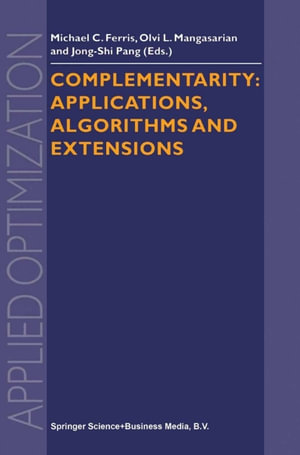
Complementarity : Applications, Algorithms and Extensions - Michael C. Ferris

Complementarity

Applications, Algorithms and Extensions

By: Michael C. Ferris, ?Olvi L. Mangasarian, ?JongShi Pang

eText | 9 March 2013 | Edition Number 1

At a Glance

eText


$239.00

or 4 interest-free payments of $59.75 with

 or 

Instant online reading in your Booktopia eTextbook Library *

Why choose an eTextbook?

Instant Access *

Purchase and read your book immediately

Read Aloud

Listen and follow along as Bookshelf reads to you

Study Tools

Built-in study tools like highlights and more

* eTextbooks are not downloadable to your eReader or an app and can be accessed via web browsers only. You must be connected to the internet and have no technical issues with your device or browser that could prevent the eTextbook from operating.
This volume presents state-of-the-art complementarity applications, algorithms, extensions and theory in the form of eighteen papers. These at the International Conference on Com­ invited papers were presented plementarity 99 (ICCP99) held in Madison, Wisconsin during June 9-12, 1999 with support from the National Science Foundation under Grant DMS-9970102. Complementarity is becoming more widely used in a variety of appli­ cation areas. In this volume, there are papers studying the impact of complementarity in such diverse fields as deregulation of electricity mar­ kets, engineering mechanics, optimal control and asset pricing. Further­ more, application of complementarity and optimization ideas to related problems in the burgeoning fields of machine learning and data mining are also covered in a series of three articles. In order to effectively process the complementarity problems that arise in such applications, various algorithmic, theoretical and computational extensions are covered in this volume. Nonsmooth analysis has an im­ portant role to play in this area as can be seen from articles using these tools to develop Newton and path following methods for constrained nonlinear systems and complementarity problems. Convergence issues are covered in the context of active set methods, global algorithms for pseudomonotone variational inequalities, successive convex relaxation and proximal point algorithms. Theoretical contributions to the connectedness of solution sets and constraint qualifications in the growing area of mathematical programs with equilibrium constraints are also presented. A relaxation approach is given for solving such problems. Finally, computational issues related to preprocessing mixed complementarity problems are addressed.
on
Desktop
Tablet
Mobile

More in Software Engineering

The End of Leadership - Barbara Kellerman

eBOOK

The Debugging Handbook - Johannes Kuhlmann

eBOOK

RRP $67.77

$54.99

19%
OFF