Get Free Shipping on orders over $79
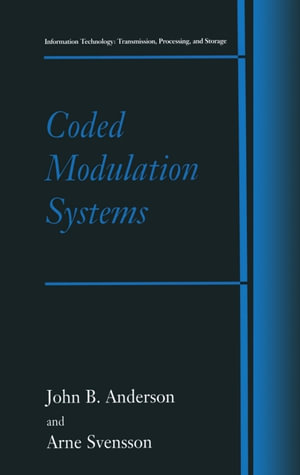
Coded Modulation Systems - John B. Anderson

Coded Modulation Systems

By: John B. Anderson, Arne Svensson

eText | 11 April 2006

At a Glance

eText


$239.00

or 4 interest-free payments of $59.75 with

 or 

Instant online reading in your Booktopia eTextbook Library *

Why choose an eTextbook?

Instant Access *

Purchase and read your book immediately

Read Aloud

Listen and follow along as Bookshelf reads to you

Study Tools

Built-in study tools like highlights and more

* eTextbooks are not downloadable to your eReader or an app and can be accessed via web browsers only. You must be connected to the internet and have no technical issues with your device or browser that could prevent the eTextbook from operating.
Coded Modulation Systems is an introduction to the subject of coded modulation in digital communication. It is designed for classroom use and for anyone wanting to learn the ideas behind this modern kind of coding. Coded modulation is signal encoding that takes into account the nature of the channel over which it is used. Traditional error correcting codes work with bits and add redundant bits in order to correct transmission errors. In coded modulation, continuous time signals and their phases and amplitudes play the major role. The coding can be seen as a patterning of these quantities. The object is still to correct errors, but more fundamentally, it is to conserve signal energy and bandwidth at a given error performance. The book divides coded modulation into three major parts. Trellis coded modulation (TCM) schemes encode the points of QAM constellations; lattice coding and set-partition techniques play major roles here. Continuous-phase modulation (CPM) codes encode the signal phase, and create constant envelope RF signals. The partial-response signaling (PRS) field includes intersymbol interference problems, signals generated by real convolution, and signals created by lowpass filtering. In addition to these topics, the book covers coding techniques of several kinds for fading channels, spread spectrum and repeat-request systems. The history of the subject is fully traced back to the formative work of Shannon in 1949. Full explanation of the basics and complete homework problems make the book ideal for self-study or classroom use.
on
Desktop
Tablet
Mobile

More in Communications Engineering & Telecommunications

Meshtastic Made Simple - Dave Hayes

eBOOK

Fundamentals of O-RAN - Nishith D. Tripathi

eBOOK