Get Free Shipping on orders over $79
C++ Coding Standards : 101 Rules, Guidelines, and Best Practices - Herb Sutter

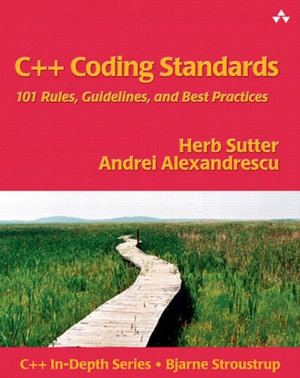
C++ Coding Standards

101 Rules, Guidelines, and Best Practices

By: Herb Sutter, Andrei Alexandrescu

eText | 25 October 2004 | Edition Number 1

At a Glance

eText


$78.95

or 4 interest-free payments of $19.74 with

 or 

Instant online reading in your Booktopia eTextbook Library *

Why choose an eTextbook?

Instant Access *

Purchase and read your book immediately

Read Aloud

Listen and follow along as Bookshelf reads to you

Study Tools

Built-in study tools like highlights and more

* eTextbooks are not downloadable to your eReader or an app and can be accessed via web browsers only. You must be connected to the internet and have no technical issues with your device or browser that could prevent the eTextbook from operating.

Consistent, high-quality coding standards improve software quality, reduce time-to-market, promote teamwork, eliminate time wasted on inconsequential matters, and simplify maintenance. Now, two of the world's most respected C++ experts distill the rich collective experience of the global C++ community into a set of coding standards that every developer and development team can understand and use as a basis for their own coding standards.

The authors cover virtually every facet of C++ programming: design and coding style, functions, operators, class design, inheritance, construction/destruction, copying, assignment, namespaces, modules, templates, genericity, exceptions, STL containers and algorithms, and more. Each standard is described concisely, with practical examples. From type definition to error handling, this book presents C++ best practices, including some that have only recently been identified and standardized-techniques you may not know even if you've used C++ for years. Along the way, you'll find answers to questions like

  • What's worth standardizing--and what isn't?
  • What are the best ways to code for scalability?
  • What are the elements of a rational error handling policy?
  • How (and why) do you avoid unnecessary initialization, cyclic, and definitional dependencies?
  • When (and how) should you use static and dynamic polymorphism together?
  • How do you practice "safe" overriding?
  • When should you provide a no-fail swap?
  • Why and how should you prevent exceptions from propagating across module boundaries?
  • Why shouldn't you write namespace declarations or directives in a header file?
  • Why should you use STL vector and string instead of arrays?
  • How do you choose the right STL search or sort algorithm?
  • What rules should you follow to ensure type-safe code?

Whether you're working alone or with others, C++ Coding Standards will help you write cleaner code--and write it faster, with fewer hassles and less frustration.


on
Desktop
Tablet
Mobile

Other Editions and Formats

ePUB

Published: 25th October 2004

Instant online reading in your Booktopia eTextbook Library *

More in Programming & Scripting Languages

Foundations of Cloud Computing : Foundations - Robert Shimonski

eBOOK

RRP $209.94

$188.99

10%
OFF
The Rust Programming Language, 3rd Edition - Carol Nichols

eBOOK

Thinking in Calculus - Nick McIntyre

eBOOK

RRP $67.77

$54.99

19%
OFF