








Lucy Jago is an award-winning writer of fiction and non-fiction, and a former documentary producer for Channel 4 and the BBC. Her first book, The Northern Lights, won the National Biography prize and has been translated into eight languages; her YA novel, Montacute House, met with critical acclaim in the US and the UK. Lucy was awarded a Double First Class Honours Degree from King’s College, University of Cambridge, and a master’s degree from the Courtauld Institute, London. Lucy is a Fellow of the Royal Literary Society and lives in Somerset.
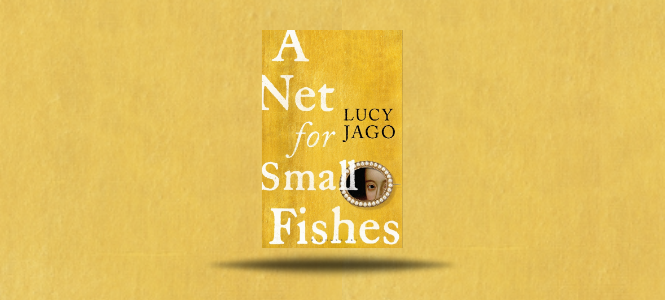
A Net for Small Fishes is her debut novel, and today Lucy Jago is on the blog to answer a few of our questions about it. Read on …

Lucy Jago (Photo by Johnny Ring).
Tell us about your book, A Net for Small Fishes!
LJ: In 1615, a doctor’s widow and a countess were arrested in connection with the murder of Sir Thomas Overbury. The alleged victim had called the countess a ‘whore’ and virulently opposed her marriage to the King’s favourite. At the widow’s trial, Lord Coke, both prosecutor and judge, pronounced her to be a ‘whore, sorcerer, witch, bawd, papist, felon and murderer’. A Net for Small Fishes tells the story of the real women so virulently condemned by Coke and dismissed by many historians since.
Anne Turner and Frances Howard are the enigmatic protagonists of your novel. How did you find their story and what drew you to writing about it?
LJ: I was in the London Library, St James’s Square just off Piccadilly, and vividly recall reading two or three lines on Frances Howard and Anne Turner, summing-up their ‘evil deeds’, and I remember feeling cross and being sure their lives and motives were not as simple and reprehensible as the book implied. The crime of which they were accused, poisoning an innocent man already incarcerated in the Tower of London, was of the ‘vilest’, according to the judge, motivated by the women’s lust and vanity. The scandal had a profound impact on Jacobean society, it has been much analysed in respect of the men it involved (the King, his closes advisors and favourites) and yet Anne and Frankie are barely mentioned and their ‘lustful’ and ‘vain’ motivation not questioned – with one notable exception, the book by David Lindley, The Trials of Frances Howard. I wanted a more complex picture of the women’s friendship than I could find even in the best books on the subject.
That moment in the London Library led to many years of research (I am still finding new information about the period that I wish I could put in the book) to try to find out who the real women were behind the simplistic and dismissive portrayals of them in most of the history books.
At the centre of this novel is the remarkable friendship between Anne and Frankie, one that gains them as much trouble as it does power. Why do you think it’s important for novels to explore these kinds of complex and intense female friendships?
LJ: As Novalis wrote, ‘Novels arise out of the shortcomings of history.’ Historical ‘evidence’ is fragmentary and the majority of human experience, especially that of women, the ordinary, the poor, is never recorded. Where facts are known, they are strung together with narratives of the historian’s invention and Frankie (as she was called by her relatives, or even Frank) and Anne’s history has been co-opted more than most, even during their lifetimes, to score political points for or against the Stuart Court, for or against arranged marriages, divorce, women’s independence, and even the wearing of make-up. I thought they deserved more careful attention.
What kinds of research did you do to recreate the court of King James I and write this novel?
LJ: To imagine, vividly and convincingly, scenes which are not in the historical record (such as when Anne met Frankie) you have to be very familiar with the period, so familiar that you can travel back not as a tourist, but as a friend and observer. This takes voracious reading of both history books (of different periods) and Jacobean texts and visiting archives, museums, galleries and surviving buildings, so that you become accustomed to the place and notice what Anne and Frankie might have noticed, not only what catches your 21st century eye.
We’ve seen with recent royal dramas like The Crown that readers and audiences can be less receptive to writers taking creative liberties with real historical events. How did you approach the task of turning history into a compelling work of fiction here?
LJ: I understand an audience’s desire to know ‘is it true’? The Crown’s protagonists are mainly still alive, or only recently dead, and so there is a sense that we can know the truth about events, that there can be a single truth. There are, of course, facts that can’t be argued with, such as the date an heir to the throne dies or a trial begins, and those I have kept true to in A Net for Small Fishes … in fact, a large part of the difficulty in structuring the narrative was keeping true to incontrovertible facts which were not always convenient in terms of creating an interesting narrative.
Looking at events 400 years old, the difficulty arises that very little was written down and, of course, nothing by those who were illiterate. Most of life – our conversations, minor or even major family arguments, insecurities, phobias, loves, fondness for mint chocolate, intense dislike of horses, and so on – is never written down. The ‘historical record’ is exceedingly fragmentary and biased and even historians piece shards of ‘fact’ into a coherent re-telling of history with narrative and coloured by their own biases. ‘Historical events’ are moments of life experienced by people, each of them with their own perspective – what was true for the Queen might feel very untrue to her son. Just ask your own family to retell an event to see how conflicting the accounts are.
So, the historical novelist must know the archives, read the historians, find out the cost of stockings, the smell of silkworm nurseries, the size of shops, because this is how we know the horizons of possibility when we seek to know the desires and fears of our characters.
What, do you find, is the most rewarding thing about writing historical fiction?
LJ: The constant learning and surprises; I am greedy for new experiences. I think I really took to heart my great-grandad’s phrase, oft repeated by my mother, ‘there’s sleeping enough in’t grave’. Looking at a portrait, Frankie’s for example, and knowing that the yellow starch in her ruff was fashionable but rebellious (and patented by her friend, Anne Turner), and showing so much of her chest was not seen as a ‘feminine’ thing to do but somewhat aggressively masculine, and to know how her lips were made red and how blue veins were painted onto her whitened flesh and so on, it makes you feel she could pull herself off the canvas and walk around the gallery with you.
How did you come to be a writer?
LJ: Slowly! I wrote a lot as a child and even won a few competitions but it never occurred to me that I could actually be a writer (questions of how we absorb ideas of what is possible and what is not is definitely part of A Net for Small Fishes). As I turned 30 I decided to quit documentary TV production and write full-time and, fortunately, I received a good advance for my first book and have kept going ever since.
What was the last book you read and loved?
LJ: I am currently re-reading Katherine Mansfield’s short stories and loving her unconventionality.
What do you hope readers will discover in A Net for Small Fishes?
LJ: I hope they will discover a world with enough similarity to make them see their own a little differently and enough strangeness to make them grip the book a little tighter.
And finally, what’s up next for you?
LJ: I have started researching a new book, set in England at a later period than is A Net for Small Fishes, also about a real historical figure with a fascinating story …
Thanks Lucy!
—A Net for Small Fishes by Lucy Jago (Bloomsbury Australia) is out now.

A Net for Small Fishes
Frances Howard has beauty and a powerful family – and is the most unhappy creature in the world. Anne Turner has wit and talent – but no stage on which to display them. Little stands between her and the abyss of destitution.
When these two very different women meet in the strangest of circumstances, a powerful friendship is sparked. Frankie sweeps Anne into a world of splendour that exceeds all she imagined: a Court whose foreign king is a stranger to his own subjects; where ancient families fight for power, and where the sovereign's favourite may rise and rise – so long as he remains in favour...

Comments
No comments