








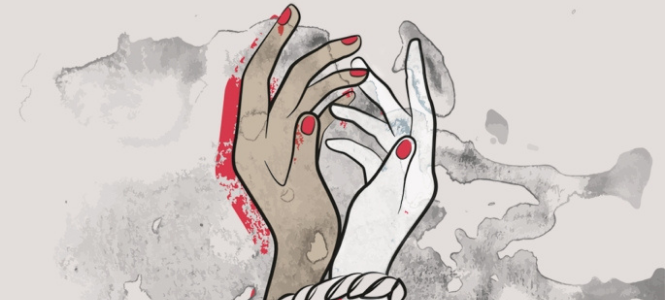
Gunfire Lullabies is a riveting and gut-wrenching account of two women caught in a war inspired by real life events, written by former diplomat, political advisor and press secretary Nore Hoogstad.
Today, Nore Hoogstad is on the blog to answer our Ten Terrifying Questions! Read on …

Nore Hoogstad
1. To begin with why don’t you tell us a little bit about yourself – where were you born? Raised? Schooled?
I was born and raised in Adelaide, a place I consider to be a big country town, three years after my parents migrated there from Holland having paid their own way. They yearned for space after being forced to live in a loft in Amsterdam, which was all that was available in the post-war years. If left in my early twenties for other pastures.
2. What did you want to be when you were twelve, eighteen and thirty? And why?
When I was twelve years old I wanted to be an artist and writer. At that age, I entered a children’s picture book about the environment into a competition and won first prize.
When I was 18 I wanted to be a dancer and was learning classical, modern, tap and Spanish dance. It was fun and I was passionate about it, but truthfully, I started too late to achieve what I wanted.
When I was 30 I was in my dream job. After trying my hand at many different things, I got a degree in Asian Studies and Literature, and became a diplomat. The main reason I applied was that I wanted to travel the world while I worked, and after living as a struggling artist with two children, I also looked forward to a regular income.
3. What strongly held belief did you have at eighteen that you don’t have now?
One of the strongest beliefs I had at age 18 is that my life would be worthless if I didn’t find my purpose, and that this purpose would be one thing that would last my whole life. I was, and still am, the kind of person who always wants to be working towards something for the greater good. Now I know that my purpose is simply to be and to trust that. It’s the HOW I do this that matters most. This has meant I’ve done many things in my life, but always serving people because that’s what brings me the most joy and contentment.
4. What are three works of art – this could be a book, painting, piece of music, film, etc – that influenced your development as a writer?
I remember standing in front of Van Gogh’s Starry Night at MOMA in New York and being completely transported to another world by these simple swirls of colour on canvas. It struck me that this is what art should do, and that I wanted to strive for moments of this in Gunfire Lullabies for my readers. Also the statue David, which was all out of proportion close up – for example the hands are huge, but when viewed from a distance is perfection. This taught me to trust my sense of how to put things together in my writing so their sum is something greater than the parts. There are too many writers, novels and how-to books to mention, but I did a free MOOK at an American university that taught me the immense command of nouns and verbs in writing.
5. Considering the many artistic forms out there, what appeals to you about writing a novel?
I love the power of words telling stories – their capacity to hint at things, the power of what they don’t say, their ability to manipulate and hit you in the face with their bluntness, and ultimately, how they come together to make you laugh, feel angry, or cry. For me, the writing process is deeply satisfying in a way that nothing else is.
6. Please tell us about your latest novel!
Gunfire Lullabies is inspired by real life events I experienced as a former diplomat. It’s a gut-wrenching fictionalised account of East Timor’s turbulent 1999 independence ballot – which ended in mass-scale destruction and much tragic death – as told by junior Australian diplomat Ava and East Timorese farmer Isabel.
‘For me, the writing process is deeply satisfying in a way that nothing else is.’
Ava, on her first posting, must decide whether she’ll gloss over the spiralling violence as her domineering ambassador demands, or report the truth in the hope the Australian government will intervene and save the East Timorese. Isabel is kidnapped by militia leader Gabriel as his sex slave after her brother escapes into the jungle rather than join his group. Alone but hopeful, she waits to be rescued. When a human rights group asks her to spy on Gabriel, she’s seduced by the promise she’ll be reunited with her family. Each woman must decide what price they’re willing to pay for freedom and truth.
7. What do you hope people take away with them after reading your work?
I hope people are entertained, inspired and gain more understanding about the very real and difficult choices some people have to make in their lives. In other words, I hope readers might ask themselves what they would be willing to stand up for. This feels pertinent in the interesting times we find ourselves in now.
8. Who do you most admire in the writing world and why?
In general I most admire writers unafraid to speak their truth using powerful stories expressed in transcendent words. Patrick White stands out with veracious portrayal of human nature – our darker, but also most vulnerable and loving sides. Gabriel Garcia Marquez’s writing style transfixed me in my early writing days.
9. Many artists set themselves very ambitious goals. What are yours?
If I could wave a magic wand I’d be finishing the first draft of my second novel and be well on the way to writing the non-fiction book I have planned. In short, I have a lot of ideas and not enough time or patience. I know I always want to write, until the day I die.
10. Do you have any advice for aspiring writers?
My best advice would be, first, persist no matter the many highs and lows (as Churchill said, never, never, never give up); second, always be open to learning from others but don’t give up your vision for your story, or you’ll end up with something that tries to please everyone but satisfies no one; and finally, in deciding whether you publish your book yourself or via traditional publishing, there are advantages and disadvantages to each, so weigh them and go for it without regret.
Thank you for playing!
—Gunfire Lullabies by Nore Hoogstad is out now.

Gunfire Lullabies
Jakarta, 1998. Junior Australian diplomat Ava Vuyk is on her first overseas posting when she's assigned the conflict-ridden issue of East Timor with its long independence struggle.
The new Indonesian regime announces a vote in which the East Timorese will choose their future, but the military and local militia oppose it, launching a brutal campaign of terror and destruction. Amid the turmoil, her collapsing marriage and the hint of new love, Ava must decide whether she'll gloss over the spiralling violence as her domineering ambassador demands, or report the truth in the hope the Australian government will intervene...

Comments