








Dr Kathryn Heyman is the author of the memoir, Fury, published in Australia and the UK in May 2021. Her previous novels include Storm and Grace and Floodline. Her work has won and been nominated for awards in Australia and the UK including the Scottish Writer of the Year Award, the Wingate, the West Australian Premier’s Literary Awards, the Orange Prize and the Arts Council of England Writers Awards. She received the 2017 Copyright Agency Author Fellowship for Fury and is an Honorary Professor of Humanities at the University of Newcastle and the director of the Australian Writers Mentoring Program.
Today, Kathryn Heyman is on the blog to answer a few questions about Fury. Read on …

Kathryn Heyman
Please tell us about your book, Fury.
KH: Fury is the story of a year in my life after a traumatic sexual assault trial, when I ran away to work as a deckhand on a trawler in the Timor Sea, and it saved me.
Can you tell us a little bit about how your love of reading and writing helped you to find a path to recovery?
KH: Growing up in an environment marked by poverty and violence, I had few role models, few examples of how to navigate my way into a different kind of life, a different kind of story. What I did have was the luck of books. The luck of a teacher who began sending books home with me, and the luck of local charity shops selling boxes of books for the price of a bag of mixed sweets. Those books saved my life. They became my templates for a better kind of story, templates for an escape plan. Lying awake listening to the sounds of violence and fear, I returned to the lives in my books, plotted escape routes, learned about my own resilience as I immersed myself in the lives of the characters I read. So when, at twenty, I needed to escape my life after a traumatic sexual assault trial, I knew the place to turn for salvation. Books. When I hitch-hiked my way out of the city I was in, and then on to a trawler in the Timor Sea, I carried with me a lifetime of reading and a backpack full of books. The books weighed over ten kilos. Imagine Reese Witherspoon in Wild, falling over with the weight of her pack. That was me. Except that my pack wasn’t full of pans and shoes, it was full of books. But it was the lifetime of books that saved me, that remade me. Not in the ‘now I am the hero’ sense, or in the ‘now I have a happy ending’ sense. Reading taught me to keep getting up, it taught me to speak possibility into being, to imagine new stories for myself. But more than any of that, reading taught me this: name the mess, name the trauma, and from that you will find a way forward. The heavy journals I carried with me allowed me to begin to name abuse and trauma for what it was, and they allowed me to imagine and write a new kind of life into being. But it was the reading that taught me how to do that. After a wild season at sea, I stepped back onto land physically strong and internally transformed. I needed the weight of all those books to make me ready and to teach me what might be possible.
Running away to become a deckhand on a fishing trawler is a pretty unconventional way to deal with trauma. Why do you think it worked for you?
KH: Is it unconventional? On those boats there are a lot of people who have run away from trauma. The Gulf then was full of misfit and outcasts, people for whom the world was a little too much, or not enough. I suspect it still is. And I think that might be one of the reasons it did work for me. On the Ocean Thief, I was surrounded by people who didn’t judge me for the accidents of my birth, or for what had happened to me. Only one thing mattered: were you ready to work? There is a lot to be said for the consolations of work, and of being useful. The other reason is that the trawler allowed me a circuit-breaker – a sense of being elsewhere. And being elsewhere allows you to be different, free of other people’s versions of you. That meant I could safely – without fear of shame or judgement – dig around in the mess of me and try on something new. And it worked. I wouldn’t recommend working on a trawler as a salve for everyone – but I would recommend a circuit breaker of some kind. And, to paraphrase the poet Philip Larkin, I celebrate the power of strangeness to make new sense of yourself.
What was the most surprising thing about life on the Ocean Thief for you?
KH: Life on a trawler is full of polarities – splendid isolation, yet you’re never entirely alone; stunning natural beauty set against industrial ugliness; silence and noise; stillness and churning. Everything is extreme. But the thing that really surprised me, back then, was that on a boat with four men, all of them strangers, in the middle of the ocean, I was safer than I’d been in a city taxi or walking home on a suburban road. Not because of anything I did or did not do, but because of what those men choose to do, or not to do.
How would you define ‘heroism’?
KH: Oooh, that’s a tricky one. I think it’s tended to be defined as a male role, one in which great feats of derring-do are performed. The original Greek word means ‘defender’ – and I would hold that definition. Heroism is the act overcoming obstacles to defend what you value.
‘When women like Grace Tame and Brittany Higgins stand in public forums and demand to be heard, they refuse to be made complicit in their own abuse.’
Why do you think there is power in writing and sharing stories about sexual assault and recovery?
KH: Sexual assault, unlike many other crimes, is often coated in shame. And shame creates silence. Speaking, writing – naming assault and abuse for what it is – punctures that terrible silence. In doing so, it repositions the shame, puts it where it should be: with the perpetrator. When women like Grace Tame and Brittany Higgins stand in public forums and demand to be heard, they refuse to be made complicit in their own abuse. When the silence around sexual abuse is removed, we move towards a culture in which the shame is also lifted. And then we move towards recovery.
Can you tell us a little bit about your journey towards becoming a writer?
KH: As a young woman I did secretly know that I wanted to write. But I’d never met a writer and had no sense of how you might go about becoming one. I had to take a series of small steps, following the thread that was in front of me. I had met some actors, though, so I went to drama school for a bit and became an actor myself. Because this gave me access to the world of theatre, I could see the next step, so I wrote a play, which led to being commissioned to write other plays. I was touring with a theatre company in the UK when I began to write what became my first novel, and then I enrolled in an MA in Writing in Sheffield. I had some really exceptional and focused teaching as part of that program, from the Caribbean poet EA Markham and from the English writer Jane Rogers, among others. That gave me the confidence to learn about narrative structure in novels, and then to submit my first novel to my dream agent. What I’m describing here are external steps of course – they don’t really describe the inner wrangling that most writers go through. I know that I wanted to write more than I wanted anything else, and that was what I held fast to, regardless of what was happening in my external life.
What is the last book you read and loved?
KH: The book I most love is always the one I have just finished – I am a very committed and passionate reader, so I often grieve a little for the book I’ve just put down. In this case, it’s a novel by Hannah Bent, a writer I mentored some time ago. When Things Are Alive They Hum is yet to be published but it’s so tender and funny and powerful, I know that when it hits the shelves next year readers will fall deeply in love with it, as I did.
What do you hope readers will discover in Fury?
KH: I hope they will discover the possibilities of transformation. My great and secret hope is that Fury will give readers what the experiences I’m writing about gave me: hope and possibility, the knowledge that you can remake yourself, whatever has gone before.
And finally, what’s up next for you?
KH: I’ve been working quietly on two books – one is secret and the other is a writing book. After more than two decades teaching and mentoring and talking about how understanding story can transform your life, I thought it was time to put it in writing.
Thanks Kathryn!
Fury by Kathryn Heyman (Allen & Unwin) is out now.
If you need help with any of the issues raised in this Q&A, call 1800 RESPECT (1800 737 732) any time for confidential information, counselling and support in cases of sexual assault, domestic violence or abuse. Visit the website to chat online and find services in your area.
For 24/7 support, call Sexual Assault Counselling Australia on 1800 211 028.
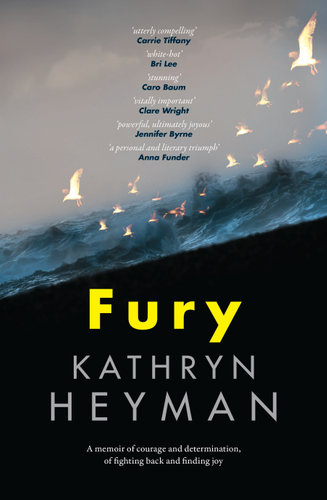
Fury
Limited Signed Copies Available!
This is the story of becoming heroic in a culture which does not see heroism in the shape of a girl.
At the age of twenty, after a traumatic sexual assault trial, writer Kathryn Heyman ran away from her life and became a deckhand on a fishing trawler in the Timor Sea. The life she left behind was beyond broken. Coming from a family of poverty and violence, she had no real role models, no example of how to create a decent life, how to have hope, how to have expectations. But she was a reader...

 Bestsellers: Scott Pape and Ash Barty continue to prove a hit with readers!
  Bestsellers: Jane Harper and Aunty Donna prove a hit with readers!
Comments
No comments