








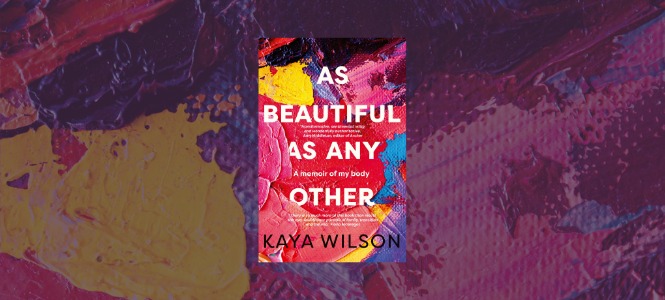
Kaya Wilson is a writer and tsunami scientist based in Canberra. His non-fiction writing blends essay and memoir to explore universal themes of identity, gender and origin. As Beautiful As Any Other: A memoir of my body is his first book.
Today, Kaya Wilson is on the blog to answer a few questions about his debut memoir. Read on!

Kaya Wilson
Please tell us about your book, As Beautiful As Any Other.
KW: I like to think of my book as an invitation into my life and I did my best to really include the reader and be generous to perspectives other than mine. The story is about me coming to understand my body after a serious surfing accident and during the process of gender transition. It’s also about me recalibrating my position in society as both a man and a transgender person. This book has been a huge part of me over the last few years and that really comes out in the writing. You, the reader, are there with me for all the self-realisations and the joys and tragedies. It’s also got a bit of science mixed in, and feminism, and a bit of playful lyricism.
At the time of your surfing accident, you were already on the journey of questioning your gender. How did the experience of a physical injury change that journey for you?
KW: Experiencing such an extreme injury where I had to question my future in a really immediate way was definitely an accelerant. Any vestiges of denial or self-deception were absolutely wiped out. But it also really drove home the vulnerability of how a trans body might be seen or treated. I talk in the book about how I was wheeled around the hospital and surrounded by health professionals as I lay on a surgical table. Part of what was going through my mind was how I might be treated if my body was in some way gender-unexpected. There are moments in life where we really need other people to help us and I wasn’t sure that the kind of help I was being afforded would always be there if I transitioned. It was an extreme situation and mental state to be making any decisions in but the question on my mind was of how I would continue to live and the answer was crystal clear.
Who did you write this book for? Who do you wish would read it?
KW: I didn’t know I would be published and so the book had to start out for myself. As time went on that expanded and as interest in the book grew, I had to really address this question. In the end I wrote for a wide net and with an open hand. I want people to come to this book with the generosity I gave in writing it. So I guess I wish lots of people would read it. Writing from a place of marginalisation, yes I do want people with an unchallenged prejudice to be disarmed and come away with an enhanced respect for transgender people. For the queers of this world, I also hope they can read it and feel heard and strengthened. And just for anyone, I would want them to enjoy the universality of what it offers.
You explore your personal trauma in this book, but you also write about the shared experience of it — your family’s after your father’s death, the queer community’s, and so on. What feels different about trauma when it’s a shared experience?
KW: Isn’t everything easier when it’s shared? Solidarity is a powerful experience and some of my most galvanising moments have been when the queer community has really come together and expressed resistance to imposed oppression. One of the more damaging aspects of trauma is when it is silenced or denied expression and so when we can unify in our experiences, it can strengthen us and our ability to cope. There are of course traumatic experiences that divide us and I think that’s something we need to work as a community to prevent.
‘Solidarity is a powerful experience and some of my most galvanising moments have been when the queer community has really come together and expressed resistance.’
You’re the coordinator of a media list of transgender writers and/or writers with intersex variations. What kind of an impact has this list had on the Australian media landscape? What do you hope to achieve with it in the future?
KW: The List was started by the writer Tom Cho and I took over a few years ago when he moved to Canada. Since it started, it has had a few successes including several publications. I believe Alison Evans was first approached by their publisher through the list and has done well since. It has also offered the media a database of trans writers and writers with intersex variations so that there is no excuse not to include our voices, especially when our rights are being debated.
I honestly think it’s time to hand it over to some enthusiastic writer keen to take it to another level and perhaps seek out grant money and other opportunities. Democratic terms are probably a good idea with these things!
You’re also a tsunami scientist. Can you tell us a little bit about how you came to be one and what you love about it?
KW: Of course! Well I have always worked and studied in the field of marine science. I specialised in seabed mapping and worked in that field for a while. The skills required for seabed mapping are very useful when it comes to tsunamis and I was offered a tsunami modelling job which then became a PhD and now another job. It has enhanced my understanding of the ocean and also enabled me to participate in a research culture that is both high-end science and benefits society. I find it exciting and meaningful and like I am contributing in a positive way.
Tell us about a writing-related memory that brings you joy.
KW: Going to Varuna was a special experience. Writing NSW granted me the 2019 Varuna fellowship where they send you to the Varuna writer’s house in the Blue Mountains for 7 days. It’s a lovely place in beautiful surrounds and they take good care of you. But mostly, it was the first time that I felt like my writing was important and deserved the reverence that Varuna gives it.
What is the last book you read and loved?
KW: I’m going to say Jessie Tu’s A Lonely Girl is a Dangerous Thing. I thought it was excellent and I just tore through it.
What do you hope readers will discover in As Beautiful As Any Other?
KW: I hope they will discover a sense of commonality that they didn’t expect.
And finally, what’s up next for you?
KW: Well I have been a little too busy this last year. So what’s next is lazy weekends, looking after my veggie garden, and some jaunts around the country to writer’s festivals! But who knows, I don’t tend to spend much time without a driving obsession and anything could happen.
Thanks Kaya!
—As Beautiful As Any Other: A memoir of my body by Kaya Wilson (Pan Macmillan Australia) is out now.
Kaya Wilson

As Beautiful As Any Other
A memoir of my body
When Kaya Wilson came out to his parents as transgender, a year after a near-death surfing accident and just weeks before his father's death, he was met with a startling family history of concealed queerness and shame.
As Beautiful As Any Other weaves this legacy together with intimate examinations of the forces that have shaped Wilson's life, and his body: vulnerability and power, grief and trauma, science and narrative...

Comments