








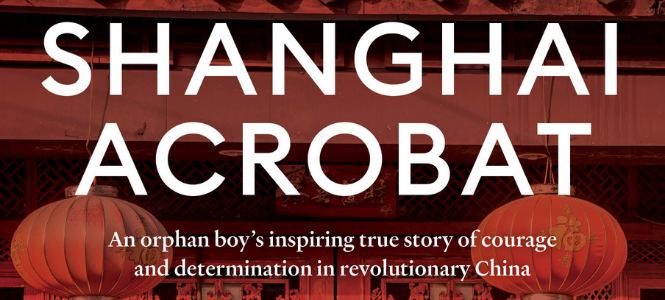
Jingjing Xue was a star performer with the Shanghai Acrobatic Troupe. Considered one of China’s best acrobats, from 1961 to 1987 he performed around the world with the Shanghai Circus. He has trained performers in China and at the National Institute of Circus Arts in Melbourne. Three of his students have won gold medals in international circus competitions. Shanghai Acrobat is his first book.
Today, Jingjing Xue is on the blog to answer our Ten Terrifying Questions! Read on …

Jingjing Xue
1. To begin with why don’t you tell us a little bit about yourself – where were you born? Raised? Schooled?
Due to reasons unknown, even to date, to me, at the age of 2 or 3, I was brought to Shanghai by my maternal uncle and sent to an orphanage. I began learning at 5, and spent 6 years in the orphanage. At the age of 9, I was picked up by the Shanghai Acrobatic Troupe and started a 5-year training, along with some studies.
2. What did you want to be when you were twelve, eighteen and thirty? And why?
At the age of 12, I hadn’t any aspirations yet. At 18, and also at 30, my dream was to be the top acrobat in the world.
3. What strongly held belief did you have at eighteen that you don’t have now?
My beliefs held at 18 haven’t changed.
4. What are three works of art – this could be a book, painting, piece of music, film, etc – that influenced your development as a writer?
Pushkin’s Monument influenced me the most, as he had said in it, ‘News of me will spread throughout great Russia’.
The Sound of Music is my favourite movie and ‘The Coronation of Napoleon’ held in the Louvre is my favourite painting. They inspired me on the path of my writing.
5. Considering the many artistic forms out there, what appeals to you about writing a memoir?
Different life experiences could be written into different stories. My past lingers in my mind all the time, so the story was easy for me to write about.
‘Listen to the callings in your heart. Choose one goal, and go for it.’
6. Please tell us about your latest book!
My book is about the development and struggle of an orphan, from the lonely orphanage to the bitter oceans of the acrobatic troupe. I have developed and improved myself in the setbacks, and forged a strong will to come back and fight another time. Because of this, I was able to adapt myself to the difficult situations in times to come. That was how I started as a helpless orphan, but went on to the international stage and became a top acrobat, and coach. My proudest moments were: when my Chinese students won two gold medals in international competitions; and my Australian student won a gold medal in an international competition. The latter was a breakthrough for Australia.
7. What do you hope people take away with them after reading your work?
Even when you had been defeated, while licking your own wounds, you should still maintain the smile of hope towards life.
8. Who do you most admire in the writing world and why?
The great writer Lu Xun is my favourite, and I like his work, Kong Yi Ji, the best. This Chinese character is reminiscent of Don Quixote, who was living in his own imagined world and his actions were pathetic and laughable.
9. Many artists set themselves very ambitious goals. What are yours?
My aim is to tell my life story which could be remembered as an autobiography, that reflects the times in which the events happened. I want readers to learn about things that happened during that period of time.
10. Do you have any advice for aspiring writers?
Listen to the callings in your heart. Choose one goal, and go for it. Don’t look up. Don’t look down. Don’t look back. Don’t look around.
Thank you for playing!
—Shanghai Acrobat by Jingjing Xue (Black Inc. Books) is out now.

Shanghai Acrobat
For readers of Mao's Last Dancer comes the inspiring true story of a world-famous acrobat who escaped communist China to begin a new life in Australia.
Jingjing Xue was born in China in the 1950s, during one of the worst times in the reign of communist leader Mao Zedong, or Chairman Mao. Mao's extreme five-year industrialisation plan left much of the population starving, destitute and gripped with fear. Jingjing, abandoned to an orphanage as a young boy, was destined to a life of hardship before officials singled him out to train with the Shanghai Acrobatics School...

 REVIEW: Growing Up in Country Australia
  Read an extract from We’ve Got This!
Comments
No comments