








Barry Divola is a journalist, author and broadcaster born and bred in Sydney, and now living in Perth. He is one of Australia’s longest-serving and best-known music critics, interviewers and feature writers. He is a regular contributor to The Sydney Morning Herald, The Australian Financial Review and Qantas Magazine. He was a senior writer for Rolling Stone (Australia), the long-time music critic at Who magazine and his work has appeared internationally in Rolling Stone, Spin, Entertainment Weekly, Monocle and many other magazines in the US, the UK, Japan, Germany and Italy. Driving Stevie Fracasso is Barry’s first novel, but he has published eight books – four non-fiction books, an award-winning book of short stories (Nineteen Seventysomething), and three children’s picture books. He plays in three bands in two cities, but has been advised not to give up his day job.
Today, Barry tells us about the inspirations behind Driving Stevie Fracasso, a novel about music, family, second chances, the wide open road, New York City, 9/11 and finding everything you didn’t even know you were missing.

Barry Divola (Photo by Neil Wallace).
‘So, where did the idea come from?’
As my old pal Billy Shakespeare would say, that is the question. And now that my novel is finally out there, I find myself being asked that question a lot. In order to answer it I have to cast my mind back ten years to remember. Yes, it’s sad but true. I’ve had this idea for a decade and it’s taken that long to become a book.
Driving Stevie Fracasso is the story of two brothers who haven’t seen each other in almost 30 years. They find themselves stuck together in a stolen 1985 Nissan Stanza on a road trip from Austin, Texas to New York City in the days leading up to 9/11. Younger brother Rick is a jaded music journalist who has just lost his only paying writing gig, his long-term girlfriend and his apartment in the space of 24 hours. He’s thrown a lifeline with a commission to write a book about his estranged brother Stevie, who was the frontman with late ’70s cult band Driven Distraction before he blew his chances and his mind. They drive through New Orleans, Clarksdale, Memphis, Nashville, Knoxville and Philadelphia, trying to piece together their fractured family past and their uncertain future.
After I gave the novel to my wife to read she said, ‘It’s not about you, but everything in there is so you.’ And as is so often the case, she’s right. I wanted to make up a completely fictional story that was also completely mine.
So, where did it come from?
It quite literally begins – and ends – with New York. To say I love New York is an understatement. It’s not just my favourite city, it’s one of my favourite things. I’ve never lived there but I’ve visited almost every year since 1991. I’m obsessed with it and as a journalist I’ve been writing travel stories, music stories and general features about it for a long time. I find the place inexhaustible. I usually go in the northern autumn, around September or October. So in 2001 I landed 10 days after 9/11. My friends and family assumed I’d cancel my trip that year but I’m so glad I didn’t because I saw the city in a whole new light. I hung out in Union Square every night, where hundreds of people gathered to try to connect and understand what had happened, and I saw how raw that time was for many New Yorkers, but also how it softened them and made them more open. Everything about that time stuck with me and I knew I wanted to write about it one day. The novel is in large part my love letter to the city.
Secondly, there’s the music. I’ve been a total music nerd since I was a kid. I ended up turning it into a career by becoming a music critic and journalist, so I knew it would loom large in the book. I wrote the novel to my own personal soundtrack that included The Replacements, The Velvet Underground, The Modern Lovers, Wilco, Nada Surf, Sonny Rollins, John Coltrane and more. Their songs not only evoked the various moods of the book, but they often influenced the story and sometimes even entered the narrative. In fact, you can find a playlist here.
‘I’ve taken many road trips in the US and they all had a big impact on me – the sense of possibility, the romance of it, the freedom of the open road.’
Thirdly there’s Rick and Stevie, the brothers who are the main characters. Yes, I have a brother. No, he’s nothing like Stevie. He’s younger than me, for a start, and he’s a boat builder, not a former rock musician. The two brothers come from my imagination, but as I’ve interviewed countless musicians, I got a bit of help from my dayjob when it came to creating their two separate worlds. I used to be a senior writer for Rolling Stone and in the space of 12 months, for two completely separate stories, I happened to interview a couple of sets of brothers who were musicians. In each case, the elder brother had mental problems. That meant there was volatility and a lot of troubles in the brothers’ relationship, but I was struck by the loyalty and sacrifice and moved by the strength of the love that one had for the other even when things got really, really bad. Rick and Stevie’s story is not the story of either of those sets of brothers, but interviewing them helped spark some ideas about my two fictional brothers and what shape their story could take.
And finally, I wanted a road trip in there. I’ve taken many road trips in the US and they all had a big impact on me – the sense of possibility, the romance of it, the freedom of the open road. I also love road movies and I thought a road trip would help structure the book, as there was movement and a timeline, with different cities and different characters the brothers could meet along the way.
On my first big US trip in 1991 I spent ten weeks circumnavigating the US, first in a Greyhound bus and then in a rental car, stopping in 23 cities and falling in love with the entire country. I’ve taken a bunch of road trips since then. I’ve driven Highway 1 all the way up the California coast, I’ve driven through Yosemite National Park and I’ve driven around the San Juan Skyway in Colorado. In 2014 I drove Highway 61 from New Orleans to Memphis via Mississippi, following a road that takes in the history of jazz, blues, soul and rock and roll.
And back in 1994 I travelled with my buddy Frank from Los Angeles to Memphis, via Arizona, New Mexico, Texas, Louisiana, Arkansas and Tennessee. Our aim was to get to Graceland for the anniversary of Elvis’s death so we could take part in the annual candlelight vigil. We stopped at every roadside attraction along the way. A few of them are fictionalised in Driving Stevie Fracasso – the swimming pig, the world’s biggest roadrunner, the toy town. And the car in the book is based on the old Datsun with no air-conditioning we drove on that trip in the middle of a scorching US summer.
It’s a cliché because it’s true – it’s not the destination, it’s the journey. And although the journey on the way to publishing Driving Stevie Fracasso may have been long and winding, I wouldn’t have missed any of the stops along the way for anything.
—Driving Stevie Fracasso by Barry Divola (HarperCollins Australia) is out now.

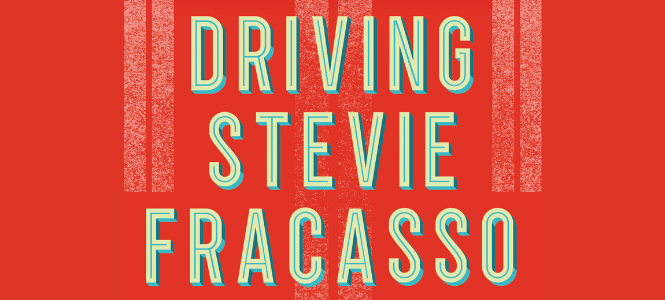
Driving Stevie Fracasso
Jaded music journalist Rick McLennan knows his life is going south when he loses his job, his apartment and his long-term girlfriend all on the same day. But then he is thrown a lifeline - a commission to write the story of his ex-rock-star brother, Stevie, and drive him from Austin, Texas, to New York to play one final gig. One small problem: the brothers haven't spoken in thirty years.
Rick knows it's a bad idea. But he's out of choices. So he gets behind the wheel of a beaten-up 1985 Nissan Stanza and drives towards his destiny. He's about to find everything he didn't know he was missing. It's September 2001...

 What do we know about the Boy Swallows Universe Netflix show?
  Booktopia’s top thrilling fiction picks for Crime Month
  Booktopia’s Top First Nations Book Recommendations for 2023
Comments
No comments