








Jessica Sanders is an author and social worker; however she considers herself as more of a ‘social impact entrepreneur’. Jess has a passion for creating resources that nurture positive mental health and promote gender equality. Every project she pursues is born from the question, ‘Why does it have to be this way?’. Jess’s first book, Love Your Body, was born from Jess’s refusal to accept that every girl is destined to grow up disliking her body. Jess has since published Me Time and the follow up to Love Your Body for boys, Be Your Own Man.
Today, Jessica is on the blog to share the inspiration behind Be Your Own Man and why it was an important book for her to write. Read on!

Jessica Sanders
When I wrote Love Your Body, I let myself imagine a world where every girl learned to love her body. When I wrote Be Your Own Man, I dared to dream of a world where every boy was free from the pressure of being a ‘real man’.
As a part of my research for Be Your Own Man, I visited a school to ask a group of 40 children aged 10-12 what they thought about gender. I read them Love Your Body, and then we did an exercise where the children drew a man on a blank piece of paper and a woman on the other side. I then asked them to write words around their drawings that they associated with men and with women. Some children were confused by the exercise, and much to my delight told me that men and women could do and wear whatever they wanted and that they thought it was a trick (it kind of was). However, the vast majority drew heavily on gender stereotypes. The most concerning was the boys who had written ‘pushes down feelings’ next to their drawings of men. After they had completed the activity we all sat on the floor and I told the children to close their eyes.
I then asked them a series of questions, and if their answer was ‘yes’ they were to raise their hand. I asked them if they felt they had to act a certain way or do certain things because of their gender. Every child raised their hand. I then asked them to raise their hand if they had ever made someone else feel like they had to act a certain way because of their gender. Over half of the students raised their hand. I then asked them to raise your hand if you want to live in a world where everyone is free to be themselves no matter what their gender is. Every child raised their hand. When they opened their eyes I told them what had happened. I told them that this change started with them, in the classroom. That they make the decision to either embrace difference and celebrate all the parts of their classmates, or to restrict and shame one another. After this powerful experience, I knew two things for certain:
1. Children felt restricted by gender stereotypes at an early age, and
2. They wanted to be free from them.
I hoped that Be Your Own Man would be an important tool in helping young people realise that they can be anything and everything no matter what their gender.
Both girls and boys are restricted by gender stereotypes, but their experiences of gender are different. Girls, whilst often valued for their appearance first and foremost, are widely encouraged to be strong and step into the masculine parts of themselves. We are far less comfortable, however, with encouraging boys to express the feminine parts of themselves. This rigid male stereotype is particularly harmful to the mental and physical health of boys. Emotional expression, for example, is an incredibly important part of staying mentally and physically well, but boys are not given the space to cry freely or be vulnerable. A survey of 1,000 young Australian men aged 18 to 30 conducted by The Men’s Project found that young Australian men who believe in outdated masculine stereotypes such as ‘men don’t show emotions’ were themselves at higher risk of using violence, online bullying, and sexual harassment, engaging in risky drinking and reporting poorer levels of mental health.
For a long time, masculinity or ‘the man box’ or masculine stereotype has remained largely unexamined. If you google the term ‘toxic masculinity’ today, you’ll find around 8.5 million results. Never has the male stereotype been under greater scrutiny. This is a good thing–we are beginning the process of freeing boys and men from what has been a limiting and harmful ‘box’ that they felt they needed to squish into. However, the second part of the conversation–what the opposite of toxic masculinity is and what healthy masculinity looks like–is not being had nearly enough.
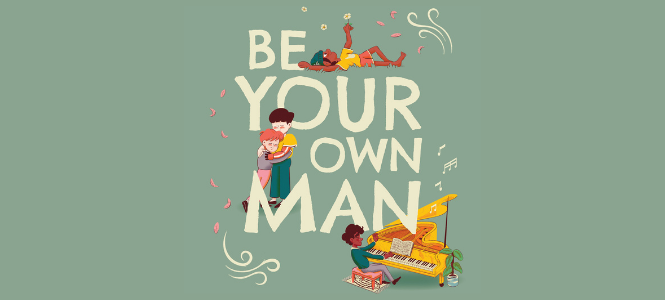
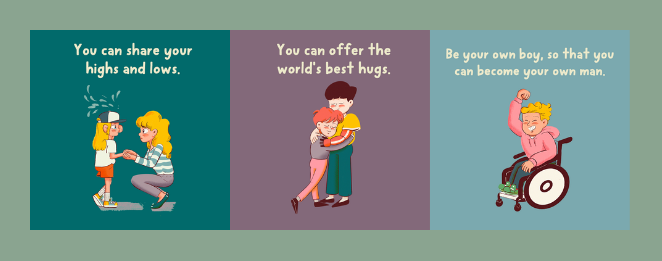
I wrote Be Your Own Man to support boys (and their parents) to move towards creating a new world where boys are free to be themselves and to support them in navigating a changing landscape for males. I intentionally reframed soft qualities, the ones that boys are told to fear such as asking for help or vulnerability, to be both brave and strong. And in the book, I hold the reader’s hand as together we break down male stereotypes and rebuild a new male identity that is grounded in softness, respect for others, and authenticity.
—Be Your Own Man by Jessica Sanders & illustrated by Robbie Cathro (Five Mile Press) is out now. Listen to our podcast with Jessica here!
This book is featured in our Kids Month Top 50 collection!


Be Your Own Man
From the bestselling, award-winning author of Love Your Body.
You can be anything. You can be everything. Have you ever felt you should act a certain way or do certain things, just because you're a boy? This book encourages young boys to broaden their ideas about what it means to be a boy, supporting them to feel free and proud to be who they truly are. Every boy deserves to be themselves without apology, and know that being themselves now will make them the man they will become in the future...

 The Best Books of 2020: Kids & YA
Comments
No comments