








Frané Lessac is an author and illustrator of international renown, having over forty children’s books published throughout the world. She was born in the USA and lived on the Caribbean island of Montserrat and London before moving to Australia. Frané has contributed her distinctive paintings to many critically acclaimed children’s picture books, including Simpson and his Donkey and Australian Baby Animals.
Today, Frané Lessac is on the blog to answer a few of our questions. Read on!

Frané Lessac
Your latest book is Australian Baby Animals. Can you tell us a little about it?
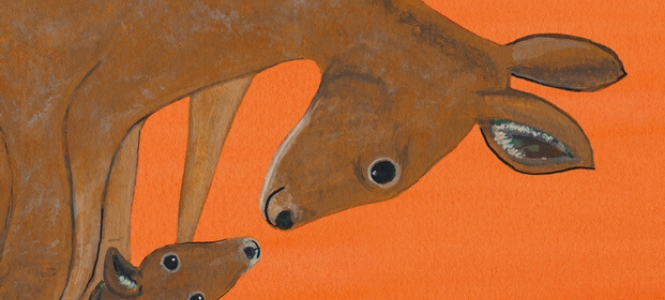
FL: Australia has some of the world’s most unique wildlife. There’s nothing cuter than a baby animal and Australian Baby Animals is a celebration of all the cheeky, adorable, furry, scaly and feathery favourites that make you go ‘awww.’ To showcase the animals, I grouped them by their baby names; joeys, hatchlings, fry, chicks, puggles, pups and platypups. I also added an extra fun fact that would appeal to older curious readers.
Did you learn anything surprising about Australian animals while working on this book?
FL: Seeing a baby snuggled up with a parent is heart-warming, and similar to human babies, many animal parents work as a team to provide care for their offspring. There were a few surprises while creating this book. How sea dragon dads are the ones that get pregnant, carry the baby fry and give birth. How some baby animals are reared solely by their dads. Emu dads sit on their eggs, without leaving the nest to drink or eat for months. Once the chicks hatch, he continues looking after them for about six months, teaching them the ways of the world. Another extraordinary fact is the bond between a crocodile mum and its hatchings. The crocodile mum will protect its babies for around two months in a creche.
You write and illustrate your own books. What’s it like to do both for a children’s book, rather than just illustrate (as you did with Mark Greenwood for Simpson and His Donkey)?
FL: I enjoy writing and illustrating equally the same. When Mark and I work on a project together, while he’s writing, he keeps my art in mind. He knows that I will take the text literally and will paint lots of detail. He’s prepared to take a loss on the word count once the art is complete. To express what he wants to say in fewer words makes him work harder, but I believe in our collaboration, nothing is lost. When I’m writing my own books, the story comes first, but it doesn’t stop me from imagining the composition, colours, visual cues and humour that I’ll eventually use to enhance my words.
When you’re writing a book by yourself, do you come up with the story or the illustrations first?
FL: I know what I’d like to paint and sometimes choose places that will work visually, but the words need to stand alone on their merit. A clear concept and story always come first. I need to get the manuscript just right before creating sketches, and eventually, the final art. My editor, Sue Whiting, who is also an award-winning author, motivates me to write my best.
Where do you find the inspiration for your books?
FL: I’m continually looking for new ideas, that universal story that will empower children. A character or a setting might generate the initial spark to write or illustrate a story, but most of all, curiosity. Touring schools give me a chance to meet hundreds of eager-to-learn young people and it’s their questions that spurn me on.

What do you love the most about writing and illustrating picture books?
FL: Researching! These days, I’m writing and illustrating a lot of non-fiction books. This allows me to travel vicariously, walk in someone else’s shoes and explore new worlds. Every project is challenging and rewarding, and I learn so much during the research process. I then, in turn, impart that information in words and art to young minds in hope it inspires them to go out and discover more.
Who are some other authors and illustrators that inspire you?
FL: The genius of Shaun Tan, the humour of Alison Lester, and the craft of Jeannie Baker.
There’s a lot of author/illustrator young guns who are making their mark in the children’s publishing world in a big way. Their energy and dedication are an inspiration—creators like Briony Stewart, Karen Blair, Kylie Howarth, Kelly Canby and James Foley.
What is the best piece of writing advice you have ever received?
FL: Read, read, read. This builds vocabulary and grammar skills and may even introduce new story ideas. It’s the best way to see how the rhythm and flow of a story work. It shows how every writer has a unique voice and reinforces the reality that all authors have gone through a process. As a writer, one needs preparation, patience, determination, dedication and a bit of luck to see a project through to being published.
And finally, what’s up next for you?
FL: Exciting news! Australia Under the Sea 1,2,3 will be out later this year. It’s a counting book looking at Australian coral reefs with loads of fun fish and other sea creatures in the same style as Australian Baby Animals.
Thanks Frané!
—Australian Baby Animals by Frané Lessac (Walker Books Australia) is out now.

Australian Baby Animals
A classic showcase of Australian baby animals and their families for very young children from a consummate author/illustrator.
With one animal baby featured on each double page spread, this colourful introduction to iconic Australian creatures...

Comments
No comments