

Get Free Shipping on orders over $49
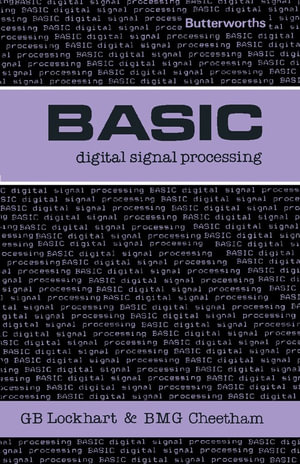
Basic Digital Signal Processing : Butterworths Basic Series - Gordon B. Lockhart

Basic Digital Signal Processing

Butterworths Basic Series

By: Gordon B. Lockhart, Barry M. G. Cheetham

eText | 12 May 2014 | Edition Number 1

At a Glance

eText


$39.60

or 4 interest-free payments of $9.90 with

 or 

Instant online reading in your Booktopia eTextbook Library *

Why choose an eTextbook?

Instant Access *

Purchase and read your book immediately

Read Aloud

Listen and follow along as Bookshelf reads to you

Study Tools

Built-in study tools like highlights and more

* eTextbooks are not downloadable to your eReader or an app and can be accessed via web browsers only. You must be connected to the internet and have no technical issues with your device or browser that could prevent the eTextbook from operating.
Basic Digital Signal Processing describes the principles of digital signal processing and experiments with BASIC programs involving the fast Fourier theorem (FFT). The book reviews the fundamentals of the BASIC program, continuous and discrete time signals including analog signals, Fourier analysis, discrete Fourier transform, signal energy, power. The text also explains digital signal processing involving digital filters, linear time-variant systems, discrete time unit impulse, discrete-time convolution, and the alternative structure for second order infinite impulse response (IIR) sections. The text notes the importance of the effects of analogue/digital interfaces, of the aspects such as sampling and quantization of the analogue input, as well as the reconstruction of an analogue output from the processed digital signal. Digital filter design consists of two separate operations: 1) approximation—the determination of a realizable system function from some idealized 'target'; and 2) realization—the formulation of a signal flow graph and its implementation in hardware or software. Digital signal processing employs the FFT, a number of efficient algorithms that compute the discrete Fourier transform and the inverse discrete Fourier transform. The programmer can run the FFT methods using some BASIC programs. The book can prove useful for programmers, computer engineers, computer technicians, and computer instructors dealing with many aspects of computers such as networking, engineering or design.
on
Desktop
Tablet
Mobile

More in Mechanical Engineering

Structural Mechanics - A. Amine Benzerga

eTEXT

Mass Flow Measurement - Jesse Yoder

eTEXT