Get Free Shipping on orders over $0
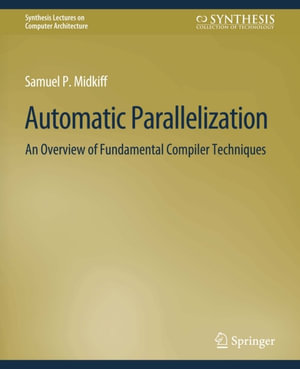
Automatic Parallelization : An Overview of Fundamental Compiler Techniques - Samuel Midkiff

Automatic Parallelization

An Overview of Fundamental Compiler Techniques

By: Samuel Midkiff

eText | 1 June 2022

At a Glance

eText


$59.99

or 4 interest-free payments of $15.00 with

 or 

Instant online reading in your Booktopia eTextbook Library *

Why choose an eTextbook?

Instant Access *

Purchase and read your book immediately

Read Aloud

Listen and follow along as Bookshelf reads to you

Study Tools

Built-in study tools like highlights and more

* eTextbooks are not downloadable to your eReader or an app and can be accessed via web browsers only. You must be connected to the internet and have no technical issues with your device or browser that could prevent the eTextbook from operating.
Compiling for parallelism is a longstanding topic of compiler research. This book describes the fundamental principles of compiling "regular" numerical programs for parallelism. We begin with an explanation of analyses that allow a compiler to understand the interaction of data reads and writes in different statements and loop iterations during program execution. These analyses include dependence analysis, use-def analysis and pointer analysis. Next, we describe how the results of these analyses are used to enable transformations that make loops more amenable to parallelization, and discuss transformations that expose parallelism to target shared memory multicore and vector processors. We then discuss some problems that arise when parallelizing programs for execution on distributed memory machines. Finally, we conclude with an overview of solving Diophantine equations and suggestions for further readings in the topics of this book to enable the interested reader to delve deeper into the field. Table of Contents: Introduction and overview / Dependence analysis, dependence graphs and alias analysis / Program parallelization / Transformations to modify and eliminate dependences / Transformation of iterative and recursive constructs / Compiling for distributed memory machines / Solving Diophantine equations / A guide to further reading
on
Desktop
Tablet
Mobile

More in Circuits & Components