Get Free Shipping on orders over $79
Advanced Pulse-Width-Modulation : With Freedom to Optimize Power Electronics Converters - Dong Jiang

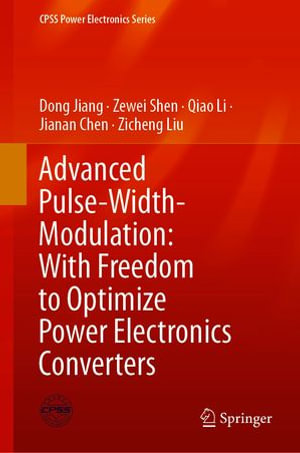
Advanced Pulse-Width-Modulation

With Freedom to Optimize Power Electronics Converters

By: Dong Jiang, Zewei Shen, Qiao Li, Jianan Chen, Zicheng Liu

eText | 20 January 2021

At a Glance

eText


$179.00

or 4 interest-free payments of $44.75 with

 or 

Instant online reading in your Booktopia eTextbook Library *

Why choose an eTextbook?

Instant Access *

Purchase and read your book immediately

Read Aloud

Listen and follow along as Bookshelf reads to you

Study Tools

Built-in study tools like highlights and more

* eTextbooks are not downloadable to your eReader or an app and can be accessed via web browsers only. You must be connected to the internet and have no technical issues with your device or browser that could prevent the eTextbook from operating.

This book is a technical publication for students, scholars and engineers in electrical engineering, focusing on the pulse-width-modulation (PWM) technologies in power electronics area. Based on an introduction of basic PWM principles this book analyzes three major challenges for PWM on system performance: power losses, voltage/current ripple and electromagnetic interference (EMI) noise, and the lack of utilization of control freedoms in conventional PWM technologies. Then, the model of PWM's impact on system performance is introduced, with the current ripple prediction method for voltage source converter as example. With the prediction model, two major advanced PWM methods are introduced: variable switching frequency PWM and phase-shift PWM, which can reduce the power losses and EMI for the system based on the prediction model. Furthermore, the advanced PWM can be applied in advanced topologies including multilevel converters and paralleled converters. With more control variables in the advanced topologies, performance of PWM can be further improved. Also, for the special problem for common-mode noise, this book introduces modified PWM method for reduction. Especially, the paralleled inverters with advanced PWM can achieve good performance for the common-mode noise reduction. Finally, the implementation of PWM technologies in hardware is introduced in the last part.

on
Desktop
Tablet
Mobile

Other Editions and Formats

Paperback

Published: 22nd January 2022

More in Circuits & Components