

The Penguin Banjo Paterson Collected Verse
Collected Verse
By: Banjo Paterson
Paperback | 2 August 1993 | Edition Number 1
At a Glance
304 Pages
2.3 x 13.3 x 20
Paperback
RRP $26.99
$22.99
15%OFF
or 4 interest-free payments of $5.75 with
His poems, written with great gusto and humour, celebrate all the romance and rough-and-tumble of old Australia. In this collection, leading Paterson scholar Clement Semmler presents more than 100 of Paterson's poems that reflect the remarkable richness and range of his writings.
Generously illustrated with period drawings, this first Penguin edition of Paterson's verse pays tribute to one of Australia's favourite sons – 'the Banjo of the Bush.'
About the Author
Andrew Barton "Banjo" Paterson OBE[2] (17 February 1864 – 5 February 1941) was an Australian bush poet, journalist and author. He wrote many ballads and poems about Australian life, focusing particularly on the rural and outback areas, including the district around Binalong, New South Wales, where he spent much of his childhood. Paterson's more notable poems include Waltzing Matilda, The Man from Snowy River and Clancy of the Overflow.
Uncle Bill
My Uncle Bill! My Uncle Bill!
How doth my heart with anguish thrill!
For he, our chief, our Robin Hood,
Has gone to jail for stealing wood!
With tears and sobs my voice I raise
To celebrate my uncle's praise;
With all my strength, with all my skill,
I'll sing the song of Uncle Bill.
Convivial to the last degree,
An open-hearted sportsman he.
Did midnight howls our slumbers rob,
We said, 'It's uncle 'on the job'.'
When sounds of fight rang sharply out,
Then Bill was bound to be about,
The foremost figure in 'the scrap',
A terror to the local 'trap'.
To drink, or fight, or maim, or kill,
Came all alike to Uncle Bill.
And when he faced the music's squeak
At Central Court before the beak,
How carefully we sought our fob
To pay his fine of forty bob!
Recall the happy days of yore
When Uncle Bill went forth to war!
When all the street with strife was filled
And both the traps got nearly killed.
When the lone cabman on the stand
Was 'stoushed' by Bill's unaided hand,
And William mounted, filled with rum,
And drove the cab to kingdom come. Remember, too, that famous fray
When the'Black-reds', who hold their sway O'er Surry Hills and Shepherd's Bush, Descended on the 'Liver Push'.
Who cheered both parties long and loud?
Who heaved blue metal at the crowd!
And sooled his bulldog, Fighting Bet,
To bite, haphazard, all she met?
And when the mob were lodged in gaol
Who telegraphed to me for bail?
And – here I think he showed his sense –
Who calmly turned Queen's evidence?
Enough! I now must end my song,
My needless anguish, why prolong?
From what I've said, you'll own, I'm sure,
That Uncle Bill was pretty 'pure',
So, rowdies all, your glasses fill,
And – drink it standing -'Uncle Bill'.
-1888
How M'Ginnis Went Missing
Let us cease our idle chatter,
Let the tears bedew our cheek,
For a man from Tallangatta
Has been missing for a week.
Where the roaring, flooded Murray
Covered all the lower land,
There he started in a hurry,
With a bottle in his hand.
And his fate is hid for ever,
But the public seem to think
That he slumbered by the river,
'Neath the influence of drink.
And they scarcely seem to wonder
That the river, wide and deep,
Never woke him with its thunder,
Never stirred him in his sleep.
As the crashing logs came sweeping,
And their tumult filled the air,
Then M'Ginnis murmured, sleeping,
'Tis a wake in ould Kildare.'
So the river rose and found him
Sleeping softly by the stream,
And the cruel waters drowned him
Ere he wakened from his dream.
And the blossom-tufted wattle,
Blooming brightly on the lea
Saw M'Ginnis and the bottle
Going drifting out to sea.
-1889
Clancy of the Overflow
I had written him a letter which I had, for want of better Knowledge, sent to where I met him down the Lachlan years ago,
He was shearing when I knew him, so I sent the letter to him just 'on spec', addressed as follows: 'Clancy, of The Overflow
And an answer came directed in a writing unexpected, (And I think the same was written with a thumbnail dipped in tar)
'Twas his shearing mate who wrote it, and verbatim I will quo 'Clancy's gone to Queensland droving, and we don't know where he are.'
In my wild erratic fancy visions come to me of Clancy
Gone a-droving 'down the Cooper' where the western drovers go;
As the stock are slowly stringing, Clancy rides behind them singing,
For the drover's life has pleasures that the townsfolk never know.
And the bush hath friends to meet him, and their kindly voices greet him
In the murmur of the breezes and the river on its bars,
And he sees the vision splendid of the sunlit plains extended,
And at night the wondrous glory of the everlasting stars.
I am sitting in my dingy little office, where a stingy
Ray of sunlight struggles feebly down between the houses tall,
And the foetid air and gritty of the dusty, dirty city
Through the open window floating, spreads its foulness over all.
And in place of lowing cattle, I can hear the fiendish rattle
Of the tramways and the buses making hurry down the street,
And the language uninviting of the gutter children fighting,
Comes fitfully and faintly through the ceaseless tramp of feet.
And the hurrying people daunt me, and their pallid faces haunt me
As they shoulder one another in their rush and nervous haste,
With their eager eyes and greedy, and their stunted forms and weedy,
For townsfolk have no time to grow, they have no time to waste.
And I somehow rather fancy that I'd like to change with Clancy,
Like to take a turn at droving where the seasons come and go,
While he faced the round eternal of the cashbook and the journal
But I doubt he'd suit the office, Clancy, of 'The Overflow'.
-1889
ISBN: 9780140146219
ISBN-10: 0140146210
Series: Penguin Australian Classics
Published: 2nd August 1993
Format: Paperback
Language: English
Number of Pages: 304
Audience: General Adult
Publisher: Penguin Australia Pty Ltd
Country of Publication: AU
Edition Number: 1
Dimensions (cm): 2.3 x 13.3 x 20
Weight (kg): 0.28
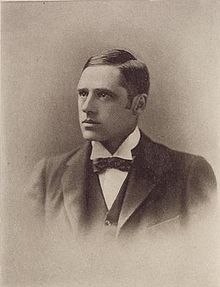
A. B. "Banjo" Paterson
He wrote many ballads and poems about Australian life, focusing particularly on the rural and outback areas, including the district around Binalong, New South Wales where he spent much of his childhood.
He best known for his rousing folk classics The Man from Snowy River and Waltzing Matilda, is widely acknowledged as Australia’s greatest and most popular balladist. His poems, written with great gusto and humour, celebrate all the romance and rough-and-tumble of old Australia.
Banjo Paterson was born at Narambla, near Orange, New South Wales, the eldest son of a Scottish immigrant from Lanarkshire on February 17, 1864. Paterson's family lived on the isolated Buckinbah Station until he was 5. When Paterson's uncle died, his family took over the uncle's farm in Illalong, near Yass. When Paterson turned 10 he was sent to school at Sydney Grammar School, performing well both as a student and a sportsman. Leaving school at 16, he took up the role of an articled clerk in a law firm and by the age of 23 Paterson was a fully qualified solicitor.
In 1885, Paterson began submitting and having his poetry published in the Sydney edition of The Bulletin under the pseudonym of "The Banjo", the name of a favourite horse. Paterson, like The Bulletin, was an ardent nationalist, and in 1889 published a pamphlet, Australia for the Australians which told of his disdain for cheap labour and his admiration of hard work and the nationalist spirit. In 1890, The Banjo wrote The Man from Snowy River, a poem which caught the heart of the nation, and in 1895 had a collection of his works published under that name. This book is the most sold collection of Australian Bush poetry and is still being reprinted today. A B (Banjo) Paterson also became a journalist, lawyer, jockey, soldier and a farmer.
In 1903 he married Alice Walker in Tenterfield. Their first home was in Queen Street, Woollahra. The Patersons had two children, Grace born in 1904 and Hugh born in 1906. He would later become a war correspondent for The Sydney Morning Herald during the Second Boer War, the Boxer Rebellion and World War I.
What genre and themes does A. B. 'Banjo' Paterson write in?
Paterson is best known as a balladist and poet of the Australian bush. His work focuses on rural and outback life, celebrating the romance, humour and rough-and-tumble of old Australia.
What are his most famous works I should know about?
His most famous pieces include the poem The Man from Snowy River and the song/poem Waltzing Matilda. Other frequently reprinted works and selections include Mulga Bill's Bicycle and various Complete Poems or Collected Verse editions.
Where should I start if I'm new to Paterson?
Begin with a collected edition such as The Man from Snowy River (collection) or a Complete Poems/Collected Verse volume to sample his best-known ballads. For younger readers, editions like Mulga Bill's Bicycle or Meet Banjo Paterson are good introductions.
Are Paterson's poems available in modern editions and formats?
Yes. His poems are widely reprinted in paperback and hardcover collected editions (Complete Poems, Penguin Collected Verse, Wordsworth editions and children's classics) and remain in print today.
Do Paterson's works need to be read in order or are they standalone?
Most of Paterson's poems are standalone ballads and can be read in any order. Collections group notable works for convenience, but there is no required reading sequence.
Shipping
| Standard Shipping | Express Shipping | |
|---|---|---|
| Metro postcodes: | $9.99 | $14.95 |
| Regional postcodes: | $9.99 | $14.95 |
| Rural postcodes: | $9.99 | $14.95 |
How to return your order
At Booktopia, we offer hassle-free returns in accordance with our returns policy. If you wish to return an item, please get in touch with Booktopia Customer Care.
Additional postage charges may be applicable.
Defective items
If there is a problem with any of the items received for your order then the Booktopia Customer Care team is ready to assist you.
For more info please visit our Help Centre.


